Wednesday, 9 May 2018

A Reconnaissance of Green Moor


The Green Moor Delf RIGS

During my brief exploration of Chancet Wood, Ecclesall Woods, the Limb Valley and the Porter Valley – as well as the villages of Norton and Grenoside - I encountered various rocks from the lower parts of the Pennine Coal Measures Group that have been exploited as building stone, for grindstones, as linings for hearths, to make bricks and crucibles and also mined for coal.

The geology around Green Moor

The Greenmoor Rock, in particular, forms several distinct features to both the south and north of Sheffield and it has been quarried extensively for paving, gravestones, cills, heads, steps at Brincliffe Edge, where its local trade name was Brincliffe Blue – on account of the blue/grey colour of the sandstone here when freshly quarried; however, over most of the length of its outcrop, this formation is largely argillaceous and used for bricks.

An old road stone quarry at Don Hill Height

The type locality of the Greenmoor Rock is about 15km to the north-west of Sheffield, just over the city boundary in Barnsley, in the small hamlet of Green Moor. Here the flaggy sandstone with a distinctive green/grey colour was extensively quarried for its paving stone and exported all over England, but particularly to London where it had its own Greenmoor Wharf.

The old road stone quarry at Don Hill Height

I first visited Green Moor back in 1996, when undertaking a survey of geological sites in Barnsley for the South Yorkshire RIGS (Regionally Important Geological Sites) Group. Although none of the several old quarry sites that I visited had good publicly accessible exposures of Greenmoor Rock, except a small spur of rock in the beer garden of the old Rock Inn, the industrial archaeology value was considered to be of sufficient importance for Green Moor to be identified as one of only five ‘showcase sites’ identified in the county.

A view along the escarpment to the west

Of these showcase sites, only Anston Stones Wood received sufficient support from the parish council and local authorities to put some good ideas into action, with its very popular geological trail, and the South Yorkshire RIGS Group had effectively ground to a halt when I was invited to visit it again by the clerk to Hunshelf Parish Council – 10 years later, following the closure of the Rock Inn and the subsequent sale of the site to a house builder.

A view down the escarpment to Stocksbridge

During a walk around the village, where the parish clerk showed me around the Hunshelf Heritage Trail and in subsequent visits when working as a consultant for the Stoneway Manor development, I came across old quarries that I had never seen before and which I thought provided much better examples of the Greenmoor Rock than that seen at the former Rock Inn.

A view east along the escarpment towards Wharncliffe Crags

As a member of the Sheffield U3A Geology Group, I had thought that Green Moor might make a good field trip, when the itinerary for the previous year’s outings was being agreed and when I was asked to jointly organise an event to replace another that was already on the itinerary, I didn’t hesitate to put this idea forward.

Discarded blocks of Greenmoor Rock in the Isle of Skye Quarry

With half of the proposed circular walk not having been yet put into practice, a preliminary visit to Green Moor was necessary, to determine the time it would likely take for a group of retired adults – usually numbering 15-20 – around a safe route that would provide some good exercise and have plenty of points of interest.

A stile incorporated into a rebuilt dry stone wall

Helped out by a local resident and parish councillor, with an excellent knowledge of the local history, we set off to explore it on an April day that had turned bright and sunny by the time we got back to the old pump house, which was to be opened specially for our group when we returned three months later.

An old track way used for moving loads of stone

Friday, 4 May 2018

Grenoside - Part 3


Grenoside Sandstone at the Cow and Calf

In Grenoside, like very many other parts of Sheffield, the architecture is generally very functional rather than ornamental and, when walking past them, there is nothing to suggest that very many of these simple buildings have considerable interest to the historian or industrial archaeologist.

Vernacular architecture on Stephen Lane

Although the quarrying activities employed half of its population c.1900, due to the great demand for stone during Sheffield’s rapid growth towards the end of the 19th century, Grenoside had previously played a great part in the development of the steel industry. The Walker brothers set up early steel crucibles there, before moving to Masbrough in Rotherham, and this provided a hub for cottage industries producing files, knives, razors and various other tools and products.

A view along Top Side

I didn’t stop to closely look at any of the buildings but, at the western end of the Conservation Area, many of the lanes that traverse the old industrial parts of the village don’t have any paths, and I think that this greatly adds to the conservation value of Grenoside.

A trough on Bower Lane

Even though none of the buildings have been listed, the general use of local Grenoside  Sandstone and Welsh slate, or stone tiles, gives them a similar character that, together with spring fed water troughs and stiles etc, are considered to have townscape merit.

An exposure of Grenoside sandstone in an old quarry face

Having partially explored the Conservation Area, I continued down Stephen Drive to Cross House Road, which together form part of a modern brick and tile housing estate, and then discovered a small exposure of a former quarry face here. Set on private land behind a small infill housing development on the right hand side, the general colouration and physical characteristics of the Grenoside Sandstone are quite visible from a distance here.

Stone roof tiles at the Cow and Calf

Continuing south to the crossroads at the end of the village, the old farm buildings that are now occupied by the Cow and Calf public house display large expanses of riven stone roof tiles and yellow coloured walling stone.

A general view of the Cow and Calf

Turning right, a short walk up Skew Hill Lane brings you to an excellent viewpoint – looking across the Don Valley to Sheffield city centre and the high ground that rises above it in the distance. In the skyline, escarpments and gentle dip slopes mark the position of various sandstones, shales and other Lower Coal Measures rocks in this part of South Yorkshire.

A view towards Sheffield city centre

Finishing my short tour of Grenoside, I then headed back down Skew Hill Lane to Salt Box Lane, where a fine substantial building constructed in Grenoside Sandstone can be seen on the right hand side. Now part of Grenoside Grange hospital, it was built in 1850 as the administrative block to the Wortley Union Workhouse and fever hospital and, with its interesting oriel window and elaborate pinnacled gables, it is surprising that this is not a listed building. 

Grenoside Grange hospital

Wednesday, 2 May 2018

Grenoside - Part 2


A memorial at Grenoside Methodist Church

When investigating the village of Grenoside to look at its building stone, although the stonework to the variety of vernacular buildings that I saw was generally weathered and the yellow colouration that I had observed in the Grenoside Sandstone at the church of St. James the Great in Norton was obvious, with this being particularly noticeable at Grenoside Methodist Church, built in 1855.

A general view of Grenoside Methodist Church

Beneath the deeply blackened surface of his simple rock faced masonry, the sandstone is distinctly yellow – especially where it has been weathered where affected by rising damp. Also, to the rear of its west elevation, several memorial slabs have been inserted into the wall and the stone used for these is strongly coloured.

Memorials set into the west elevation of Grenoside Methodist Church

The architecture style of this church is very plain and simple and these later additions adds some interesting detail although, as a memorial quality stone, it is very inferior to the Brincliffe Edge/Greenmoor Rock, whose fine grain and durability was highly valued by monumental masons all over England.

Details of memorials at Grenoside Methodist Chapel

Walking back up the hill to Main Street, the partially blackened masonry to the equally austere St. Mark’s church also reveals the same yellow colouration, which is again seen in the neighbouring church hall. The latter is particularly striking for its very unusual random rubble walling that is made of angular blocks, which is similar to the masonry seen in Whiston Methodist Church.

St. Mark's church on Main Street

I had by now spent less than half an hour in Grenoside, yet I had already found numerous interesting features - which would provide good stop off points on a geology field trip – and this continued on the rest of my short tour of this historic village.

A detail of the masonry at St. Mark's church hall

Grenoside - Part 1


The Old Harrow public house

Having completed the section of the Sheffield Round Walk that runs clockwise from Chancet Wood to the bottom of the Porter Valley and explored the village of Norton, where I encountered various examples of what I have assumed to be Grenoside Sandstone, I continued my investigation of the building stones of Sheffield with a trip to the village of Grenoside itself.

The geology around Grenoside

The origin of the name Grenoside, which is said to mean ‘a quarried hillside’, goes back to Saxon times and the various quarries here produced grindstones, furnace linings and chests for the cementation process of making steel. It also produced good quality building stone, which has been used throughout the village for the older houses, chapels and churches, the old infants school and in various public houses.

A sculpture by Andrew Vickers in Grenoside Green

Although a Conservation Area Appraisal mentions that Grenoside Sandstone has been used at Hillsborough Barracks and for fine ashlar at the Old Post Office, in Sheffield city centre, the historic buildings of Grenoside itself are not considered to possess much architectural merit. It is not mentioned in my copy of Pevsner’s guide to the historic buildings of the West Riding of Yorkshire and it possesses only one listed building.

Grindstones set into a wall on Norfolk Hill

When living in nearby High Green many years ago, I once visited Grenoside to see its Sword Dance and passed through it a couple of times on my way to Oughtibridge and I have always thought that it is a good looking village, but I had never taken a walk around it.

Edwardian purpose built commercial premises on Norfolk Hill

The last quarry closed in about 1939 and those that are marked on old maps have now been infilled and redeveloped for housing and, although a few downloaded guides to the archaeology and history of Grenoside helped me to identify a few old quarries in the woods north of the village, on this occasion I didn’t set out to explore them.

The old infants' school on Norfolk Hill

In the absence of exposed rock faces, an exploration of historic buildings, walls, kerbs, roofing flags and various other structures provides a good introduction to the physical characteristics, which make the sandstone here sufficiently different to other Lower Coal Measures sandstones to be considered a type locality and named the Grenoside Sandstone.

The principal building of the old infants' school on Norfolk Hill

The British Geological Survey memoir states that “as a rule this rock is remarkably micaceous and fissile” making it suitable for roofing tiles and that its micaceous nature makes the Grenoside Sandstone recognisable over considerable areas as a ‘marker horizon’; however, no mention is made of its colour and there is barely a reference to its other physical characteristics.

Vernacular architecture on Norfolk Hill

As usual, I had my hand lens and other geologist’s tools with me but I didn’t even touch or closely examine any of the various stones that I saw on the day – instead I just stood back and took a few photographs of my observations.

Grenoside Methodist Church

Sunday, 29 April 2018

Chancet Wood to Ladies Spring Wood


Looking down the escarpment of Greenmoor Rock in Chancet Wood

When undertaking the Porter Valley leg of the Sheffield Round Walk, problems with the bus service resulted in me having to walk twice as far as I had intended. Consequently, I didn’t have enough time to fully explore the places of interest for geologists and industrial archaeologists, which were listed in various maps and guides that I had downloaded.

A Google Map view of the southern outskirts of the City of Sheffield

Having briefly explored Norton, its church and other parts of Graves Park that I hadn’t seen before, I returned to this part of Sheffield afterwards to continue my exploration of the Sheffield Round Walk – this time from Chancet Wood to Ladies Spring Wood.

Greenmoor Rock on the Sheffield Round Walk

Looking at the Geology of Britain viewer and Google Map, I was interested to see that the paths along this section essentially follow the outcrop of the Greenmoor Rock and I was also looking forward to seeing the flora in the established woodlands that grow along the lower scopes of the escarpment - in particular the provenance of the bluebells that grow here.

Bluebells

At Chancet Wood, the path follows the contours, with a steep slope falling down to the upper end of Abbey Lane in Woodseats, and continues round to the head of a steep sided valley, where a small outcrop of Greenmoor Rock is cut through by Abbey Brook, before it continues down to Beauchief Abbey, after which it then joins the River Sheaf.

An exposure of Greenmoor Rock in Abbey Brook

This is the only part of this walk where I saw any rock exposures but, if joined with other walks like Ecclesall Woods – or one that I have in mind for Graves Park – it would be easy to include this as part of a field trip for the U3A Sheffield Geology Group or similar others.

Following the Greenmoor Rock through Park Bank Wood

After crossing the valley and Bocking Lane, the walk continues at Park Bank Wood where the path continues to follow the contours of the Greenmoor Rock and overlooks the public golf course, which is set next to Abbey Brook valley.

Beauchief Abbey

A short detour here brings you to Beauchief Abbey, which I haven’t yet seen inside but has remains that have proved to be of great value to students of archaeology from Sheffield University over the years.

Ladies Springs Wood

Walking back up the hill on the road to Beauchief Hall, I rejoined the Sheffield Round Walk at Ladies Spring Wood, where various natural springs are encountered when following the Greenmoor Rock down to the River Sheaf.

A weir on the River Sheaf

At Twentywell Lane, where I left the Greenmoor Rock and the River Sheaf to catch the train back to Sheffield from the nearby Dore railway station, the river, a main road and the railway to London are all squeezed into this part of the Sheaf Valley – and many points of interest for geologists, geographers, civil engineers, industrial archaeologists and local historians can be found here.

Wild garlic

Tuesday, 24 April 2018

St. James the Great - The Porch


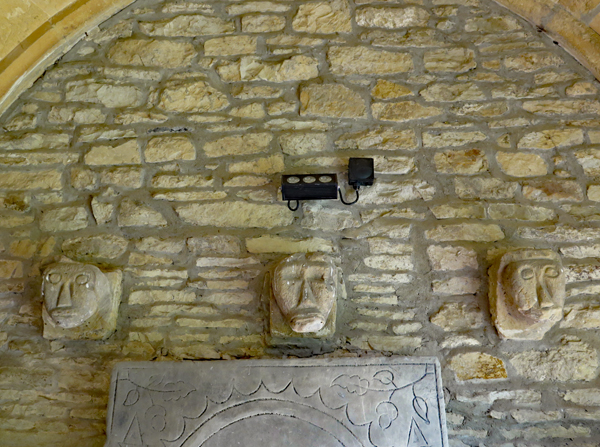
Barbaric heads from a corbel-table

The church of St. James the Great in Norton is kept locked except for services and occasional coffee mornings, like most of the mediaeval churches that I have visited, and I didn’t have the opportunity to explore its interior; however, the outer doorway to its porch is open and there are several interesting details to see here.

The doorway to the porch

The Historic England List Entry Summary describes the porch as having a “plain C13 style outer doorway with restored responds” and refers to six reset headstones, as well as the Norman mask corbels, which are alternatively described as “barbaric heads from a corbel-table” in the principal resource that the writer uses - Pevsner, N, Radcliffe, E, The Buildings of England: Yorkshire: The West Riding, (1967), 479.

Sculpted corbel brackets

I didn’t stop long enough to examine the various stones very closely but yellow/orange coloured Grenoside Sandstone is the principal building stone – seen in the dressings especially – with the green/grey Greenmoor Rock used mainly for the grave slabs.

A view of some reset grave slabs

The very heavily restored chevron decorated Norman doorway is also quite yellow and, looking up, the very fine Victorian rib vaulted ceiling is very striking with its uniform colour. The latter reminds me of Holy Trinity church in Wentworth, where I once thought that it would be a very difficult stone “to match” - if it was ever in need of repair.

The south doorway of the church of St. James the Great

This interesting church merits another visit soon, to take a good look at its interior and to re-examine a few puzzling details that I had noted when quickly looking around its exterior.
  
A reset grave slab