Wednesday, 25 June 2014

Water


Whenever I go on holiday, I like to explore my surroundings – to see the art, the architecture and the natural landscape – and to experience the different cultures too. Having never left Europe before, just being in the southern hemisphere was a wonderful experience for me. Waking up in the morning with the sun appearing to rise from the wrong direction and the night sky being completely unrecognisable, it took two weeks before I could orientate myself.

The Paraguay River

In a sub-tropical climatic zone, the fauna, flora and the weather are so different to those found in England and I was just impressed by the scale of the place – especially when seeing the rivers.

The Paraguay River is part of La Plata River basin, the second largest in South America, after the Amazon, and it is an important trade route - linking Paraguay to the Atlantic Ocean - as well as supporting the fishing industry and providing irrigation along its route.

The Paraná River marks the border with Argentina and Brazil in the south and east and, here, it cuts through the Paraná Plateau, a thick succession of flood basalts that were erupted over 100 million years ago, when the Atlantic Ocean first started to open. Although once freely navigable, two large dams at Yacyretá and Itáipu, built in partnership with Argentina and Brazil respectively, now dominate this stretch of the river.


Hydroelectricity

Paraguay is now the world's largest exporter of hydroelecticity in South America, and Itáipu is still a major tourist attraction for visitors to this part of South America, but this controversial development has resulted in the forced relocation of very many people and the destruction of Paraguay's best natural tourist attraction - the Guairá Falls

Friday, 20 June 2014

Building in Stone


Decoration with ochre, sienna and umber

The part of rural Paraguay that I briefly saw lies between the Paraguay and Paraná rivers, where the landscape comprises gently undulating hills, with only a couple of places where I could recall distinctive geographical features. The highest point is Cerro Peró, at an altitude of 842 metres, but I only passed this place on the overnight coach to Ciudad del Este, which served as a base to visit the Iguassu Falls and the Jesuit Missions.

The Trinidad Mission in Paraguay
Living in England, a small country, you don't feel that you are in the middle of nowhere, when visiting an ancient monument, with Hadrian's Wall being an exception but, at the Trinidad mission, I asked myself - how was this done?

The practicalities of arriving in Encarnación, or thereabouts, along the River Paraná, and then chopping through the vegetation, settling in this place, excavating a quarry and then moving all of the inorganic building materials - including lime and sand - to build this incredible place, are very daunting. Although a young girl did her very best to explain the history to my companions, there was nothing for me to read in English.

The museum at Trinidad Mission
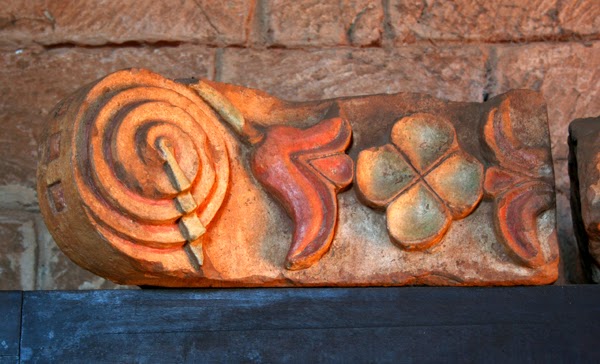
Looking closely at the various fine architectural details that can still be seen in situ, and in the small museum spaces too, I was amazed by the vivid colours that were preserved

Natural pigments such as ochre, sienna and umber, and others too, glowed brightly in the light that entered the room and, with the whole interior of the church decorated in an extravagant Baroque style, this must have been such a colourful place.

There was a small display that provided some information about the history of the mission but, again, not in English.

In the absence of natural rock exposures, a large expanse of stone masonry provides a wonderful opportunity to have a good look at the properties of the stone which, in this instance, is a medium grained, well cemented red sandstone.

Guaraní architectural sculpture
In itself, the stone isn't that remarkable but the stone carvings, produced by the Guaraní, are quite astonishing, especially since they had no experience of building in stone before the Jesuits arrived. 

There are numerous fine details to be seen but the pulpit, which is still in excellent condition, is considered to be one of the finest examples of Guaraní art to be seen anywhere in South America.

The Jesuits founded socially motivated and self-sufficient townships, not only imparting their religion but also establishing rules of public order, education and society. The young, evangelical priests organized the Guaraní into collectives and taught them new practical skills - the furniture and musical instruments were of such good quality that they could be sold in Europe.

A frieze sculpture depicting angels with musical instruments

Guaraní sculptors were known as Santo Apohava, literally "saint makers" and their sculptures were seen as much more than simple representations of holy figures; they were believed to actually possess some of the saints' power.

Along with the nearby Jesús de Tavarangue Mission, Trinidad is a World Heritage Site. A total of 30 missions grew and prospered for 180 years and, at their height, they accommodated 140,000 Guaranís. It is one of the most astonishing experiments in colonization that the world has seen.

The ruins of the Jesús de Tavarangue Mission

As a geologist, I particularly liked the way in which the remains of some of the outbuildings have been conserved. With the overlying weathering details long since stripped away, a few courses of stone have just been left to decay naturally.

Conservation in Paraguay