Thursday, 16 May 2024

An Introduction to Metamorphic Rocks

 
A thin section of staurolite viewed with crossed polars

My surprisingly busy year of travel in 2022 came to an end with my day out to Bolsterstone on 23rd November and, after spending the best part of the next 2 months writing this Language of Stone Blog, my next day out of any note was to attend the Sheffield U3A Geology Group indoor meeting on the 15th of January 2024. 
 
The introduction to my illustrated talk

Our theme for this year was the basic classification of rocks and, after Paul and Hilary - who had worked as geography teachers – had taken it upon themselves to talk on sedimentary and igneous rocks respectively, I was delegated to talk about metamorphic rocks.
 
As an undergraduate geologist at Nottingham University, metamorphic petrology was just one of our compulsory modules and a 2 week field trip based at Castle Sween in Argyll and Bute was spent studying various Dalradian rocks, but I don't remember too much about it. 
 
The geology around Keswick

I also spent 6 weeks mapping the regionally metamorphosed andesitic lavas and tuffs of the Borrowdale Volcanic Group to the south of Keswick and, when helping a girlfriend with her fieldwork at Newborough on Anglesey, encountered the regionally metamorphosed pillow lava at Llandwyn Island – part of the Mona Complex, which is Neoproterozoic to Cambrian in age. 
 
A metaquartzite cobble
 
On that occasion, I collected a large metaquartzite cobble from the beach, which contains a vein of breccia and is presumably derived from the Mona Complex. A few years later, during a 2 week driving holiday in my MG Midget, which reached as far as the whisky country and the Great Glen, I picked up another piece of metaquartzite, which clearly shows alternate sandy and clay rich beds.
 
Metaquartzite with alternating sand and clay rich beds
 
As a geologist, I have barely scratched the surface of the subject and, in the 35 years since, my only close encounters with metamorphic rocks in situ have been the schistose rocks from the Cordillera Bética at the Roman theatre in Cartagena, Palaeozoic basement rocks in the Catalan Coastal Range at Parc Güell in Barcelona and Connemara marble at the end of a 7 month spell working for the Geological Survey of Ireland. 
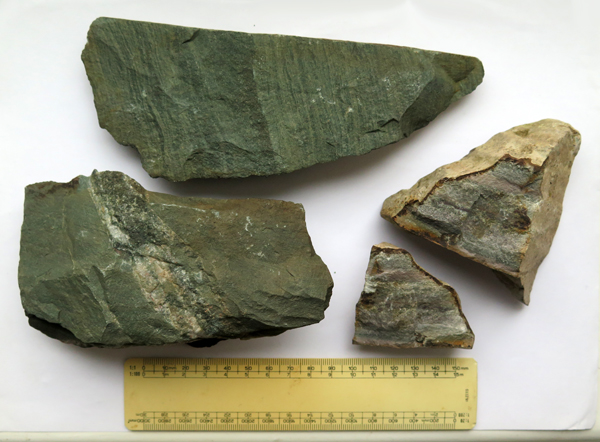
 
Metamorphosed tuff from Charnwood Forest
 
With the group limiting their field trips to a 2 hour drive from Sheffield, except for the Precambrian tuffs and granites in Charnwood Forest, the geology that they have encountered consists of a wide range of sedimentary rocks from the Lower Carboniferous to the Triassic, with the occasional basalt and tuff seen in the Peak District National Park. 
 
A diagram with the characteristics of various metamorphic rocks
 
The working background and level of education of the various members is quite varied, but with a bit of time and having explanations given out in the field, the concepts of bedding, jointing, folds and faults, as well as others relating to the geomorphology of the various landforms encountered, are generally understood; however, with the application of heat and pressure during metamorphism, the changes in mineralogy and textures introduces a whole new vocabulary and processes that aren't always easy to follow.
 
A diagram showing the development of foliation after folding
 
To explain these without reference to specimens or photographs of rock outcrops, based on my own professional experience – as I would use for my specialist subject of building stone - is quite a task, especially when only allowed an hour. As I discovered when referring to old text books and undertaking online research, appropriate illustrations and diagrams were actually surprisingly difficult to find. 
 
A diagram showing the effects of regional metamorphism
 
When meeting up with Paul and Hilary to finalise plans for the day, having spent a considerable amount of time to try and simplify a very complex subject, I was not heartened when they complained that they did not understand very many words in my PowerPoint presentation – but that just illustrates the nature of metamorphic geology! 
 
A diagram showing the effects of contact metamorphism

Being satisfied that I had pitched my talk at the right level, I went home and continued to prepare my talk using the resources that I had to hand, which included a few photomicrographs that I had taken at Sheffield University – when preparing an idea for a display at Clifton Park Museum that I subsequently developed for my Glowing Edges Designs artwork.
 
Various thin sections of rocks seen under crossed polars
 
On the day, having exceeded my allotted hour, I started to get various looks and gestures from Paul at the back of the conference room to tell me that my time was up; however, having already drawn the short straw and spent an inordinate amount of time preparing this, I was determined to complete my talk.
 
Connemara marble at the Streamstown quarry
 
Given that I had not studied the subject for more than 40 years, I was quite pleased with my effort and the feedback from the group seemed to be very positive. If asked to do this again, I would prefer to have more time and combine it with a practical session and, in the absence of rock specimens, I would make the effort to find more examples of building or decorative stone, such as the volcanic green slate plaques in the Sheffield Peace Gardens.
 
An inscription in the Sheffield Peace Gardens

Wednesday, 8 May 2024

Geology & Architecture in Bolsterstone

 
A specimen of stigmaria from Broomhead Reservoir

Wandering around St. Mary’s churchyard in Bolsterstone, I got a great panoramic view of the escarpment of Greenmoor Rock that runs to the north-west from Hunshelf Bank. This very fine grained sandstone produced the best quality paving stone, which I thought could be used to make the headstones in, but there is no record of this industry at Green Moor. 
 
A panoramic view of the Greenmoor Rock escarpment

When quickly looking at the exterior and interior of St. Mary’s church in Bolsterstone, even without getting close enough to touch it, I could see that it is built with a very coarse sandstone that I usually associate with the Millstone Grit Group, particularly the Chatsworth Grit in the Sheffield area, which often contains finger nail size pebbles. 
 
The south door surround at St. Mary's church

Looking at the geological map of the area, Bolsterstone itself is set on the Rough Rock, which has been quarried at the top of the escarpment a short distance away to the east. Where I have seen the Rough Rock in Whirlow and around Ringinglow, it is quite fine grained and thinly bedded and was used for flagstones and stone slates. 
 
I have seen a medium/coarse grained variety of the Rough Rock to the south of the very steep sided Ewden Valley at Spout House Hill, where a few small quarries are shown on the 1855 Ordnance Survey map, and the geological memoir describes the upper beds of the Rough Rock as a massive, coarse grained, sandstone. 
 
Quarries recorded in the vicinity of Bolsterstone
 
The Building Stone Database for England map explorer and the British Geological Survey map on which it is based, shows that an outlier of the Loxley Edge Rock has been extensively worked at the Allman Hill Well Quarry and the LIDAR map shows this quite clearly. 
 
The LIDAR map of the Allman Well Hill Quarry
 
The memoir states that the summit of the hill here is occupied by a “massive, coarse, in parts gravelly, feldspathic sandstone, which, but for the occurrence of the Ganister Coal some 30 to 50ft beneath it, might be mistaken for one of the coarser beds of the Millstone Grits instead of a local phase of the Loxley Edge Rock”. 
 
Very coarse grained sandstone used at the village pump
 
I don’t know if any exposures or waste rock can still be seen at this quarry, which could be matched with the sandstone used at the church, but I think that it is quite likely that the stone used for it and other buildings in the village came from here. 
 
Bolsterstone war memorial
 
Having finished everything that we needed to do at St. Mary’s church for the Bolsterstone Graveyard Project, Catherine, Sally and I then had a quick walk around Heads Lane, Folderings Lane and Walders Lane – a distance of less than 300 metres - so that I could take some photos for the British Listed Buildings Photo Challenge, which included the K6 telephone kiosk, the village stocks and Bolsterstone war memorial. 
 
Castle Cottage
 
The Grade II Listed Castle Cottage, which dates back to the late C16 to early C17, is built in what the Historic England listing describes as deeply coursed rough ashlar gritstone, with thinly coursed rubble used for the C19 addition, but I didn’t get close enough to make my own assessment. 
 
Views of Porters Lodge
 
Porters Lodge is considered to be a greatly altered mediaeval building, with the shouldered lintels to the doors and windows and leaded glass giving it a chapel like appearance. Projecting from the south elevation is the jamb and springer of an arch that is believed to form part of the entrance to Bolsterstone Castle – a possible fortified manor house built by one of the Earls of Shrewsbury and on the east elevation is a reset mediaeval mask. 
 
Vernacular architecture in Bolsterstone
 
On this very short walk in Bolsterstone, I photographed various buildings that are built in a massive coarse grained sandstone, but they are too blackened to get any idea of the colour variation within the sandstone and I didn’t examine any of them closely. 
 
Broomhead Reservoir
 
To finish the day, Catherine asked me if I wanted to go and look at the shore of Broomhead Reservoir, where she had discovered that the drop in water levels over the extremely dry summer had revealed blocks of sandstone that were were full of Carboniferous plant fossils. 
 
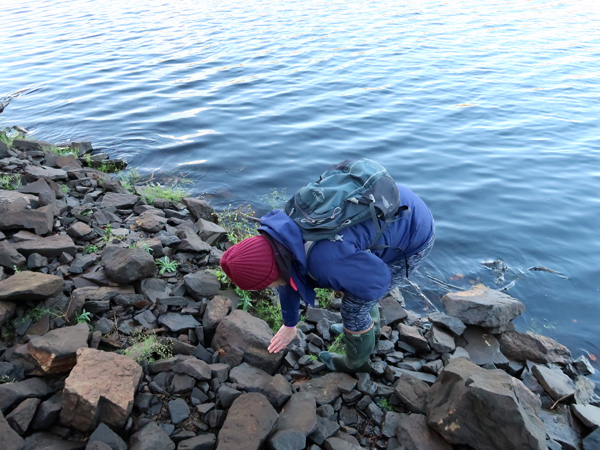
Searching for fossils
 
Although the water levels had since risen, we were still able to scrabble around and came across several blocks of sandstone with plant fossils in them. Palaeontology is not my strength and it was Catherine who spotted the stigmaria - the fossil root of a Carboniferous lycopod - that I took home with me but, once I got my eye in, I started to spot more of these.
 
A Carboniferous plant fossil
 
Given enough time, I am sure that we could have found many other specimens, but I was grateful enough to be shown these at the end of what turned out to be my last outing of 2022. One rock that stood out against all of the other loose pieces of sandstone was a large piece of what I think must have been ganister, which looked extremely fine grained and very siliceous.
 
Ganister with a stigmaria plant fossil
 

Tuesday, 7 May 2024

The Interior of St. Mary's Church

 
A view west along the nave from the chancel

Having looked at the Commonwealth War Graves Commission headstones in St. Mary’s churchyard in Bolsterstone with Catherine and Sally, for the Bolsterstone Graveyard Project, followed by a very quick walk around the exterior of the church, I entered the porch and immediately noticed the very coarse grained sandstone used for the door surround. 
 
The south door
 
Some of the blocks are planar bedded, with concentrations of orange iron oxides/hydroxides on the bedding planes contrasting with generally light brown colour of the sandstone and, despite its very coarse grain size, the carved head stops are surprisingly detailed. 
 
Head stops on the south door
 
Our visit to St. Mary’s church coincided with their regular coffee morning where, in addition to the usual biscuits and cakes, home-made soup is served – which was very welcome to us after wandering around the churchyard in the rain. 
 
A view east along the nave
 
I just had enough time to take a few record photographs of the principal elements of the interior - the nave, arcades, aisles and chancel – which are all designed in a Perpendicular Gothic style and the unplastered stonework gives an impression that the church is older than it actually is. 
 
The chancel
 
The octagonal columns, capitals and other mouldings to the arcades and arches are well proportioned and very pleasing to the eye and, perhaps due to the lack of wall memorials and brass plaques, the  church does not seem cluttered like many others I have visited. 
 
Views of the interior
 
I did not have the time to stop to examine the colours and textures in the stonework, which is presumably the same throughout the church and I just looked to see if there were any interesting sculpture or other details to photograph. 
 
An angel in the chancel
 
One feature of the church that brings the impression of a ‘mediaeval’ church back to its true date of 1879 are the carvings of heads above the arcade piers. The Early History of Stocksbridge and District no 15 - Bolsterstone 1 by Joseph Kenworthy states that these are the last six incumbents, from when the previous church on the site was built in 1791 to the time it was demolished and the new one built.
 
Incumbents of the church
 
 Looking closely at my photos of the carved heads, the sandstone used does not appear to be very course, as seen in the general walling and the carved angel corbel in the chancel. Next time I am in Bolsterstone, I will take another look at these and the font, about which I can find no information.

The font

Saturday, 4 May 2024

St. Mary's Church in Bolsterstone

 
St. Mary's church in Bolsterstone

During my trip to Bolsterstone in November 2022, the main reason for my visit was to help my friend Catherine with the identification of the stones used for the Commonwealth War Graves Commission headstones, as part of the Bolsterstone Graveyard Project, but I did take the time to have a very quick wander around the exterior of St. Mary’s church (1879).
 
A view of the south elevation
 
The church had already been photographed for the British Listed Buildings Photo Challenge, so I simply took a few general record photographs and, being in company, I didn’t closely inspect the sandstone from which it is built. 
 
A detail of the north aisle

Most of the stonework is quite blackened, which largely obscures the colour variations that may occur in the sandstone but, stopping to have a closer look at the north aisle, I could see that the massive very coarse grained sandstone varies from light grey brown to orange, with general iron staining and the formation of banding and Liesegang rings being a feature of the stonework where the patina and dirt have been weathered away. 
 
A detail of a window in the north aisle
 
Walking around the church at some distance, there has been some delamination of the tracery and window surrounds but, where the sandstone is laid on its natural bed, there is no scouring or pronounced decay – except in small areas beneath some of the string courses and other drip mouldings - and I didn’t see any signs of restoration. 
 
General views of the masonry at St. Mary's church
 
The rain and generally overcast sky eventually cleared to reveal blue sky, which enabled me to take a few photographs that better showed the general masonry to the south elevation, although again I didn’t get very close to the stonework. 
 
A view of the south elevation
 
The windows to the chancel have head stops, which I didn’t particularly notice on this occasion, but I did manage to use the zoom lens on my Canon Powershot G7 X Mark II to capture an angel and one of several dragons that project from the string course to the tower, which is just below the castellated parapet. 
 
An angel and dragon on the tower
 
The head stops to the porch depict a figure with either a crown or coronet and an archbishop, about which the only reference that I can find - Early History of Stocksbridge and District no 15 - Bolsterstone 1 by Joseph Kenworthy – states: ‘The corbels outside and inside the porch represent Sir Robert Rockley, Henry Bower, Archbishop of York and Richard de Westhall’. 
 
A head stop on the porch
 
Sir Robert Rockley (c.1340 - c.1415), who established a private chantry chapel in1412, and Henry Bowet (d.1423), Archbishop of York – who lived during the reign of Henry IV - have come up in my brief online search, but I am a geologist and not a genealogist and I am more interested in the provenance of the coarse gritty sandstone that has been used to build the church. 

A head stop on the porch