Friday, 4 September 2015

The City Walls in York


The City Walls in York

The City of York, with the most complete medieval city walls still standing in England, is deservedly one of the UK’s great tourist attractions; I have visited it many times, for pleasure, business and as an English Language teacher/field trip leader with students from Spain.

A few views of York Minster

Set in the low lying Vale of York, with the underlying bedrock buried beneath Quaternary sediments, there are no building stones found in the immediate vicinity. The Minster, the churches, various other historic buildings and the walls themselves are constructed of Magnesian Limestone - imported along the rivers from the town of Tadcaster, where the Romans had fully exploited the hard rock for building stone.

A few details of the Magnesian Limestone

Although the Magnesian Limestone has been used to build some spectacular and long lasting buildings and ancient monuments, it possesses physical characteristics that make it particularly unsuitable for intricately carved stonework.

Variations in colour and texture within the Magnesian Limestone

During the transformation from limestone into dolomite, when the Permian Zechstein Sea lapped up against the ancient sea shore of eastern Britain, it has been estimated that the volume of the rock shrunk more than 12%. This left the rock formation full of cavities, vughs and cracks – at angles that are oblique to both the planes of bedding and jointing.

A few views of the city walls in York

Some of these have been filled wholly or partially with the mineral calcite, during subsequent diagenetic processes – known respectively as shakes and vents in the stone trade. A formal history of the restoration of the English Houses of Parliament, largely constructed in a very similar limestone from South Yorkshire, would no doubt confirm the observations of Charles Dickens, when he described this stone as being “the worst ever used in the metropolis” - having seen the need for constant, expensive repair.

The Bars


Wednesday, 2 September 2015

Building Stones in Cambridge


Architectural details at the Sedgwick Museum

The starting point of the Cambridge Geological Trail is at the museum building itself – where you can see various Jurassic limestones, the unique Caithness flagstone and at least 3 varieties of brick – whose colours reflect the mineralogical composition of the clay from which they are made.

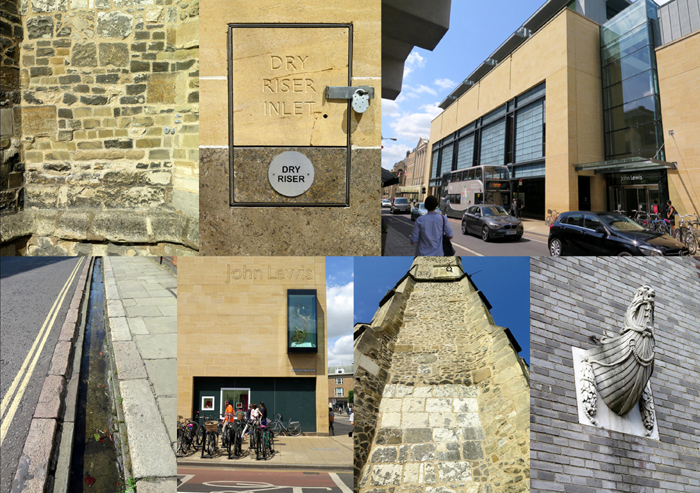
A few views of historic buildings in Cambridge

With less than an hour before I had to rejoin the Heart of England summer school, I could only take a quick look at a couple of buildings that have been highlighted in this brief introduction to the building stones of Cambridge; however, I now have a much better understanding of the buildings, constructed in several varieties of Jurassic limestone, which I have seen whilst walking around the centre of this beautiful historic city. 

Ancient monuments, modern architecture and art in Cambridge
 
A day out in Cambridge provides many opportunities for the Geotourist: ancient monuments, spectacular historic architecture and some fine art, as well as a fantastic collection of fossils; having earmarked this very special place for further investigation, I turned my attention to the next project – an exploration of the city walls in York.

Monday, 31 August 2015

The John Watson Collection


The John Watson collection of building and decorative stones

With my primary objective of having a good look at the fossil collections in the Sedgwick Museum completed, I had a brief look at another of the museum’s unique set of geological specimens – the John Watson collection of over 2500 building and decorative stones.

Pyrenean Marbles
Held in the adjoining Cambridge University Department of Earth Sciences, access to this collection requires an appointment but, on this occasion, I was given permission to take a few photos. Having worked in the specialist building restoration industry in London, where an architect’s specification typically requires that all materials used for repairs shall “match the existing”, collections such as these are invaluable for a geologist such as myself.

Although my time in Cambridge with the Heart of England summer school was running out, I bought a copy of the Cambridge Geological Trail - an introduction to building stone -  and took a very quick look at some of the historic buildings mentioned in this excellent booklet.

The Cambridge Geology Trail