Tuesday, 19 May 2020

Riverside Chambers in Derby


A detail carved in Hopton Wood limestone

My first extended stop, during my day trip to Derby, was the Sales & Information Centre at Riverside Chambers, after following the signs to the Tourist Information Centre and finding that it had recently closed. 

The entrance to Riverside Chambers

Formerly the Magistrates Court, built in 1934, this large red brick building again has gritstone dressings, with both of the visible facades being plain and simple and the splayed main entrance front being much more grand. 

The handrail and mirrored wall panels on the staircase

Once inside, the tourist information didn’t seem very extensive, and I can’t remember obtaining a map, but I asked if I could go upstairs and take a closer look at the fantastic handrail and mirrored wall panels, which are set into the polished Hopton Wood limestone panels on the staircase. 

A general view of the handrails on the first floor

This famous Derbyshire limestone developed an excellent reputation as a decorative stone, as well as for its use in Commonwealth War Graves Commission memorials, and I have encountered it in many historic buildings - Sheffield City Hall being a particularly good example. 

A detail carved in Hopton Wood limestone

Above the entrance to the Courts, there is similar decoration to that seen on the exterior door surrounds, with combinations of very finely carved and geometrical details. I just took a few photographs and, with plenty still to see in Derby, I quickly headed westwards in the general direction of Derby Museum and Art Gallery.

A detail carved in Hopton Wood limestone

A Day Trip to Derby - Part 1


The portico at Derby Council House

On the second weekend of the Heritage Open Days festival in 2019, having led a field trip in Sheffield during the week with the Sheffield U3A Geology Group, I planned to investigate a couple more churches; however, with very fine weather forecast, I took advantage of this to have a day out to the city of Derby on the Friday. 

My exploration of Derby

It had been more than 25 years since I had visited, when living in Bakewell, to take photographs of post-war architectural sculpture for the RCHME (Royal Commission on the Historical Monuments of England) and to see the White Watson tablets at Derby Museum and Art Gallery. 

The Comet in Chesterfield

On this occasion, the main reason for my visit was to see the tomb of Bess of Hardwick in Derby Cathedral, in preparation for a talk that I had been asked to give at St. Peter’s church in Edensor in a few months’ time. 

A monolith sculpture outside the bus station

With three bus journeys each way and travel time constituting the bulk of my day out, I had to make the most of the four hours that I had available in Derby. Arriving on the Comet from Chesterfield at about 12:20 pm, the first thing that I saw when leaving the bus station was a large monolithic sculpture made of Derbyshire gritstone. 

A view along Morledge from the bus station

When I visited in 1994, the bus station was a brick structure built in the 1930’s, with some nice Art Deco features and, looking around me, I couldn’t see any landmarks that looked familiar to me and so I headed off in the general direction of the cathedral, passing the QUAD arts centre that is clad in Derbyshire gritstone, with reddened slabs being used to create stripes on the facade. 

A general view of the Council House

I stopped briefly outside the Council House to look at the sawn sandstone paving from the Pennine region of Lancashire, where Extinction Rebellion had made their mark, and to look at the inscription on the clock before the road was occupied by protesters who were on the march. 

Sandstone paving outside the Council House

The building dates from 1941 and is described by Pevsner as “a poor design in an C18 style. Brick and stone dressings, with giant portico facing the roundabout”, with the pediment containing a large sculpted crest with elaborate foliage cut into the pale uniformly coloured gritstone. 

The clock outside the Council House

Derby is set by the River Derwent on the Triassic Mercia Mudstone Group, which is not generally known for its building stones except for local use but, upstream, the river passes through the area between Stanton Moor and Darley Dale, north of Matlock, which are long established sources of top quality gritty sandstone from the Ashover Grit. 

The geology around Derby

It was therefore not a surprise to discover that very many of the historic buildings of all ages, which I subsequently encountered, made extensive use of sandstones from this area – for whole structures or as elaborately carved dressings.

Derby Council House

Friday, 15 May 2020

A Geology Field Trip in Sheffield


Quarry Lane

In the month since I last went out with the Sheffield U3A Geology Group to Chrome Hill, I had travelled widely to Fishlake, Ashover, Mansfield, Barnby Dun, Barnburgh and Barwick-in-Elmet – encountering many interesting historic buildings and rock outcrops along the way.

A geological map of Sheffield

My next field trip was closer to home, and 15 of us met up at the Meadowhead branch of Morrisons supermarket on a cloudy morning in the middle of September. The purpose was to explore the variations of lithology in the Greenmoor Rock and to relate the rock outcrops, topography and geomorphology to the British Geological Survey maps.

The route of  the walk with the Sheffield U3A Geology Group

After handing out a general map of the route and looking at some maps of the meanders of the Mississippi River by Harold Fisk, we gathered at the gates to the delivery area at the rear of Morrisons, which occupies a large former quarry. 

A map of the Mississippi River by Harold Fisk

Unfortunately, despite making a formal request to gain access to this area, following a recce five months earlier, the Community Champion had not managed to act on this and we could only peer through the gates and study the rock exposure outside. 

An illustration of alluvial sedimentation

Another handout, as well as the Harold Fisk maps, helped the group to understand the vertical and lateral variation seen within the sandstone, mudstone and shale - the principal components of the Upper Carboniferous strata in Sheffield. 

In Graves Park

I had planned to spend some time at the quarry behind Morrisons, as it is the best accessible large exposure of the Greenmoor Rock in Sheffield, but instead took the group to the ponds in Graves Park, which occupy a steep side valley that cuts through the Grenoside Sandstone and underlying Greenmoor Rock. 

In Graves Park

Diverting briefly to look at some landforms that have been interpreted as lynchets, before walking down through Cobnar Wood to observe various exposures of sandstone and mudstone in the valley sides, before taking lunch at the playground at the bottom end of Graves Park. 

Observing mudstone in Cobnar Wood

After lunch, we continued with the first part of our route; however, after we had a good look at the large exposure of rock at the old brick yard, which is now occupied by Homebase/Dunelm, a few of the members who lived in this part of Sheffield left the group. 

At Heeley Retail Park

Nonetheless, the rest of us carried on down to the Heeley Retail Park, before crossing the River Sheaf - on the second part of the field trip - to look at the outcrop on Marden Road and then continuing up Brincliffe Edge to Quarry Lane, where we effectively ended our day.

An exposure of Greenmoor Rock at Quarry Lane

Sunday, 10 May 2020

Aberford


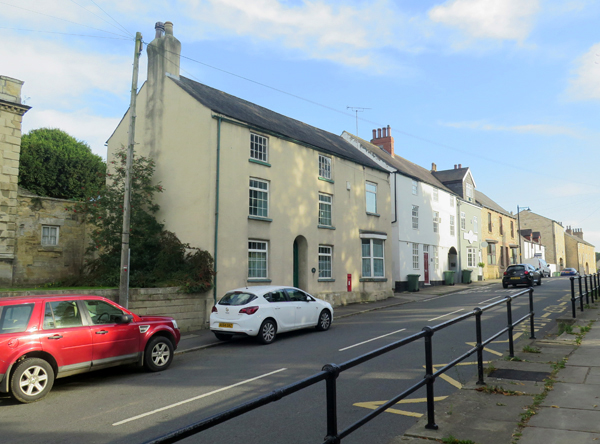
Main Street in Aberford

After a quick look at Lotherton Hall Chapel, the end of a very full day of exploration - which started at Barwick-in-Elmet - entailed a walk around the village of Aberford, where my hostess Norma dropped me off to catch the bus back to Leeds. 

Main Street in Aberford

Set on the old Great North Road, at the crossing point of the Cock River, this settlement was considered important in ancient times and in the vicinity there are the earthworks known as the Aberford Dykes and the remains of a Roman fort buried beneath Aberford House. 

Aberford House

Entering the village from the south along the straight old Roman road, we didn’t stop at the Gascoigne Almshouses on the outskirts of the village, which were once part of the Partington Hall estate, but it is just one of many fine buildings that lined either side of the street.

The former Swan Hotel

Most of the historic buildings are constructed in dolomitic limestone from the underlying Cadeby Formation but, as in Barwick-in-Elmet, many are rendered and several terraced houses are made of red brick. 

A view down Main Street to Aberford Bridge

Being dropped off at the corner of Cattle Lane, where I would catch my bus back to Leeds in 45 minutes time, I didn’t have the time to wander back to a part of the village which lies on a ridge and where there are outcrops of limestone at the sides of the road. 
After taking a few photos of Aberford House and the former Swan Hotel, one of several coaching inns in the village, I then went to find the Arabian Horse public house, where I had a well deserved pint of Theakston’s bitter. 

A pint of Theakston's bitter at the Arabian Horse public house

Having seen many points of interest while driving along Main Street, I could easily have spent a couple of hours further exploring this very attractive village - most of which is a Conservation Area - as well as enjoying some more fine beer, but I was still a very long way from home.

The Watermill

Saturday, 9 May 2020

Lotherton Hall Chapel


The south elevation of Lotherton Hall Chapel

After I had been shown St. Mary’s chapel in Lead, during my day trip to Barwick-in-Elmet, I assumed that I would now start to make my way back home but, much to my surprise, my hostess Norma then proceeded to take me to Lotherton Hall – a country house dating back to the C18, which is now owned by the Leeds Museums and Galleries service. 

A view from the nave to the chancel

Having never heard of this place before, I was particularly interested in the small dolomitic limestone chapel, comprising just a nave and chancel that dates back to the C12, but which was extensively remodelled in the C18 and restored in 1917. 

A view west along the nave

As with St. Mary’s chapel, I didn’t have the time to take a good look at the building and only took a few quick photographs of the interior and one of the south elevation of the exterior; however, a guide produced by the West Yorkshire Archaeology Service, which I have since discovered, describes various phase of construction that can be seen in the masonry and I therefore look forward for an opportunity to visit again. 

A general view of the west end

Stepping down into the chapel through the south door, the level of the floor has been lowered, but part of the original floor can still be seen at the west end of the nave, which was shortened and rebuilt during the C18. 

The stoup

On this raised platform, there is an unusual stone stoup, comprising a large elaborately carved bowl that is placed on a tall stem, which has acanthus leaves, geometric patterns and a base that is decorated with tortoises. 

Tortoises on the base of the stoup

The splayed window reveals, especially in the south elevation, exhibit the extreme thickness of the walls and, although some have been replaced with square headed windows, the slit window in the nave is original and the widened east window is in a similar style. 

A slit window in the south wall

Moving from the nave to the chancel, the original archway that links them has been modified, with the original Norman round arch being replaced by a flat lintel and the south jamb being altered to allow for the widening of the opening. 

The archway between the nave and  chancel

Looking closely at the east wall of the chancel, plaster to the window reveal is painted to mimic joints in the stonework and, to the right hand side of the top of the window, shields and flowers can still be seen on the fragment of plaster that remains. 

The east wall of the chancel

Having finished in the chapel, we then had a very quick look inside Lotherton Hall, where I just took a photo of a magnificent pietra dura table made with a variety of Italian marbles, and then returned to Aberford, where I would catch my bus back to Leeds.

A table inlaid with Italian marbles


Wednesday, 6 May 2020

St. Mary's Chapel in Lead


A general view of the south elevation

By the time that I finished looking around the interior of All Saints’ church, in Barwick-in-Elmet, it had gone 3:15 pm and I had already seen enough to make my day out worthwhile; however, Norma, one of the volunteers showing people around the church, kindly offered to show me St. Mary’s chapel in Lead, which is maintained by the Churches Conservation Trust. 

Information on the Battle of Towton

Even though I still had the best part of 3 hours of travel time to get back to Treeton by public transport from Barwick-in-Elmet, I had already eaten a substantial meal at Khao Gaeng Thai and I gladly accepted her invitation. 

A general view

After a 10 minute drive east that took us into North Yorkshire, not far from the village of Saxton, I was very surprised to see that the chapel is set in the middle of a field - just a stone’s throw away from the site of the Battle of Towton, which took place in 1461 during the Wars of the Roses. 

A general view of the interior

Believed to be the chapel of the nearby manor house belonging to the Tyas family, whose position is determined by uneven ground between the chapel and Lead hall Farm to the east, Historic England date it to the C12, with buttresses added in the C13 and C14 Decorated Gothic windows. 

A general view of the interior

Archaeological excavations in 1931, to the east of the chapel, revealed the foundations of a larger church and a grave slab that dates back to at least the C10 and, in the interior, five inscribed slabs belonging to the Tyas family are laid in the floor. 

Grave slabs belonging to members of the Tyas family

Not wanting to take advantage of the opportunity that my hostess had provided for me, I just took a few quick snaps of this very interesting ecclesiastical building – to note its construction in Permian dolomitic limestone - before we returned to her car.

The west elevation