Saturday, 28 November 2015

Fossil Marine Reptiles


The fossil marine reptile gallery at the Natural History Museum

The Natural History Museum is an extremely popular tourist attraction in London and there are often long queues to see the dinosaur gallery with its animatronic models, which can make the visitor experience a bit cramped and rushed.  Having seen these before, I chose to spend my time taking a closer look at the equally spectacular fossil marine reptiles.

Mosasaurs

Including several finds by Mary Anning and her brother Joseph, from the area around Lyme Regis on the Dorset coast, the discovery of these fossils provided a great challenge to the biblical account of the formation and age of the Earth, from which the modern geological sciences and the concept of evolution subsequently developed.

Mary Anning

The story of Mary Anning – a poor, working class and self educated woman in a rich and privileged man’s world – is fascinating and provides a great insight into the pioneering work of Henry De la Beche, William Buckland, Roderick Impey Murchison, Gideon Mantell and very many other geologists during these times.

Plesiosaurs

I have seen other fossil marine reptiles at the Sedgwick Museum and there are many more museums where they are exhibited – including Whitby Museum on the coast of North Yorkshire, which I haven’t yet seen – but to see so many different species all together in one place makes the Natural History Museum worth visiting just for these alone. 

Ichthyosaurs

Thursday, 26 November 2015

The Natural History Museum

Having spent nearly a year exploring a variety of places that are of interest to Geotourists, in South Yorkshire, West Yorkshire, Derbyshire and the Peak District National Park - using public transport - my next trip was to look at the geological specimens in the Natural History Museum.


Growing up in London, I was fascinated by row upon row of rocks, minerals and fossils displayed in old fashioned wood and glass cabinets during family trips to the old Geological Museum and, together with holidays to the coast, these sparked my lifelong interest in geology.

The cast of Diplodocus carnegii

The cast of the diplodocus in the Hintze Hall can't fail to impress any visitor, set in this magnificent example of Victorian architecture, built when Britain was at the height of its wealth and power. Although the Natural History Museum has since evolved, reflecting modern trends in museum design - for better or worse -  it is unmissable for those Geotourists who want to visit London.

A detail carved in Portland limestone

Tuesday, 24 November 2015

Cave Dale


A view of Cave Dale from Peveril Castle

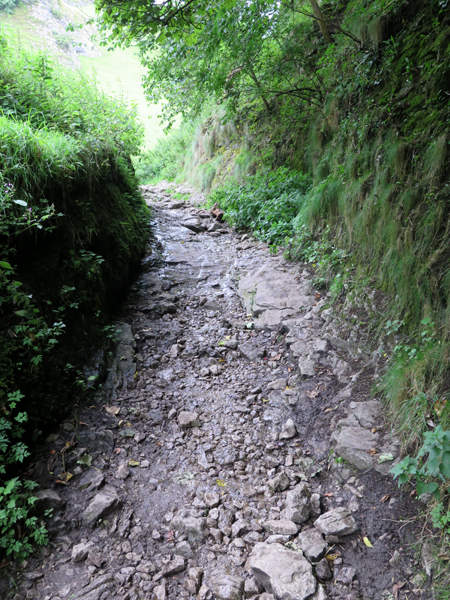
When looking down into Cave Dale, from Peveril Castle, the many groups of walkers who are traversing the upper slopes are barely visible - such is the scale of this steep sided dry valley, with crags of grey Carboniferous limestone towering above it. Having seen all that I needed to see at Peveril Castle, I had a couple of hours before my planned return bus journey to Sheffield and went back down to Castleton and set off to explore it myself.

The start of the path along Cave Dale

At the northern approach to Cave Dale, massive reef knolls of the Bee Low Limestone form towering cliffs, which have been left behind after erosion by glacial meltwater, the solution of the limestone underground to form caves and the subsequent collapse of larger caverns.

Peveril Castle

Walking up beyond Peveril Castle, which is perched on the cliffs, the valley narrows and steepens very suddenly, with the path stepping up and winding along the line of the intermittent water course that has cut into the limestone.

The Geology around Castleton

On the geological map, the transition between knoll reefs to a back reef environment is marked out here and, if I had walked a little bit further up Cave Dale, I would have seen small outcrops of columnar basalt - but time was not on my side on this occasion.

A view of Peveril Castle from Cave Dale

All along Cave Dale, it is possible to explore the limestone that outcrops near to the valley floor but, not being that interested in palaeontology as an undergraduate, I didn’t wander off the path - except to investigate an exposed mineral vein and peer into an old adit, which is a legacy of the lead mining industry in the region. 

A mineral vein

Monday, 23 November 2015

Peveril Castle


The keep at Peveril Castle

Having explored the Burbage Valley a couple of weeks earlier, I was reminded that a steep climb is quite often involved when exploring the geology of the Peak District but I had forgotten how daunting the view of Peveril Castle is, when looking up and contemplating the walk ahead.

A remnant of the curtain wall seen on the approach to Peveril Castle

Set on a steep hill, with precipitous cliffs dropping down to Peak Cavern on one side and to Cave Dale on another side, it must have once been such a formidable sight and I can't ever remember seeing such a spectacular defensive position, having explored very many of England's castles. 

Limestone walling at Peveril Castle

The geology here is the Lower Carboniferous Bee Low Limestone Formation, which was laid down in a shallow sea - as apron reefs on the edge of a shelf - and it is often rich in corals and fossil shells. The fragments of the curtain wall and other structures that still remain, and the occasional outcrops within the grounds, show the general physical characteristics of the rock.

Ashlar facing to a rubble core at the castle keep

Although the Carboniferous limestone has been used for coursed rubble walling, it is not suitable for fine ashlar and the keep is faced in gritty Carboniferous sandstone of unknown provenance; the nearest source of massive sandstone is some distance away and, thinking about moving heavy stone over such terrain, it makes the already difficult task of constructing the castle seem even more impressive.

An architectural detail

Most of the sandstone ashlar has been stripped away, leaving the rubble core exposed, but the remaining facing stones are still in very good condition, although the interior stonework is suffering from severe cavernous decay.

The interior of the keep

Peveril Castle isn’t the most impressive Norman castle in England but, once you have zigzagged up the hill to get there, the views of Mam Tor, Back Tor and Lose Hill are worth making the effort.

A panoramic view of the Shale Grit and Mam Tor Beds

These form part of a long ridge comprising the Shale Grit and Mam Tor Beds that, together with the underlying Bowland Shale, are the oldest Upper Carboniferous rocks in this part of England and were laid down as turbidites ahead of the approaching delta front.

Sunday, 22 November 2015

Castleton


A view of Castleton

It takes just over an hour by bus from Sheffield Interchange and, along the way, the Millstone Grit forms some spectacular scenery and, once in Castleton, you can explore some of the equally impressive landforms of the Carboniferous Limestone.

St. Edmund's church

On a geology field trip from Nottingham University, I was introduced to the reef knolls and associated fossils around Winnats Pass, the landslides of Mam Tor – the shivering mountain - and to the lead mining industry of the Peak District.

A close up view of Mam Tor

I have since visited Castleton many times - with friends, undertaking geological surveys by myself and with various groups of Spanish summer school students, when my skills as an English language teacher were required.
The show caves of Castleton attract tourists in their droves, and the unique banded variety of the mineral fluorite - Blue John - is still extracted in very small quantities to satisfy the demand for jewellery and gifts.

A specimen of Blue John at Clifton Park Museum

An extended stay is needed to fully explore the places that I have mentioned above but, on this occasion, I only had enough time to take a good look around Peveril Castle, which I had not visited for very many years.