Sunday, 20 November 2022

An Exploration of Malin Bridge

 
An example of the Loxley Edge Rock on Dykes Lane

Continuing my investigation of Walkley, having had a quick look at the stonework at the former Morley Street Board School, I walked down past the allotments to Watersmeet Street and carried on to Malin Bridge, where the rivers Loxley and Rivelin converge. 
 
Watersmeet Island

I stopped to have another look at the part of the riverbed at Watersmeet Island, which in previous visits I noted has an unusually high amount of rusty brown iron staining. The Upper Carboniferous rocks around Sheffield often have a very iron content and ochreous deposits are often seen in streams where there has been microbial weathering of pyrite associated with coal seams and are very often discharged from old coal mining adits. 
 
The River Loxley at Malin Bridge

This staining seems to largely derive from the lowest stretch of the River Loxley, as seen in the river next to the Grade II Listed former Malin Bridge corn mill, which has one of the few remaining examples of an undershot water wheel in Britain. 
 
The former Malin Bridge corn mill

Looking closely at the stonework, the sandstone is very coarse grained, variable in colour, from buff to rusty brown and, in places, it has well defined graded beds. It is quite unlike the Crawshaw Sandstone that I had seen to date on my travels and lacks the pebbly beds that are a characteristic of the Chatsworth Grit. 
 
Coarse grained sandstone used for walling

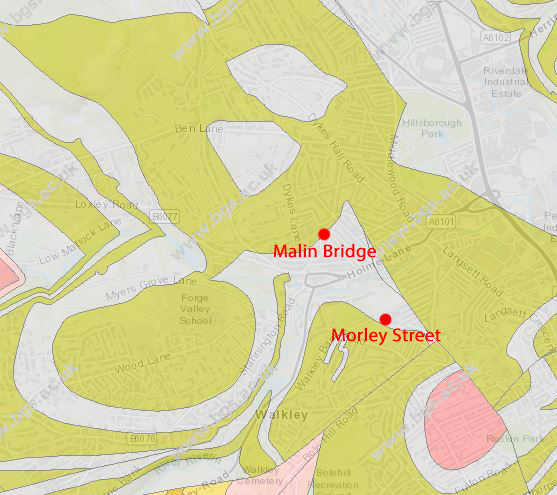
Referring to the geological map, the predominant sandstone found around Malin Bridge is the Loxley Edge Rock, which I think is most likely to be the source of the stone for the corn mill, although the Middle Band Rock, which is not recorded in the geological memoir as being used as a building stone, also occurs in the area. 
 
The geology around Malin Bridge

Having noted the physical characteristics of this stone, I went to find a recently erected relief sculpture by the Sheffield based letter cutter/stonemason Steve Roche in the car park of the newly built Lidl supermarket. Carved in an unspecified massive buff sandstone, it depicts items that were included in insurance claims by landowners in the area, whose property was destroyed in the Great Sheffield Flood of 1864. 
 
A sculpture by Steve Roche at the Lidl supermarket

The very patchy wetting of the wall by the recent rain rather spoiled its appearance and, making a mental note to come back and photograph it another day, I began my walk up Dykes Lane on the way to Wadsley, where the transition from the low lying soft mudstones of the Pennine Lower Coal Measures Formation to the gritty Loxley Edge Rock forms a steep incline. 
 
Handrails on Dykes Lane

As I had already discovered in Walkley, the junctions of the roads and footpaths in Malin Bridge have also been carefully designed to accommodate the needs of pedestrians when walking up and down the hills in this part of Sheffield – as at Blake Street - with handrails in place to enable them to cope with the very slippery slopes in winter. 
 
A carefully designed path on Dykes Lane

Carrying on up Dykes Lane, I had a very quick look at St. Mark’s church and another interesting building on the corner with Hibberd Place but, with 14 more buildings in Wadsley and Hillsborough still to photograph for the British Listed Buildings website, I just took a few quick snaps to add to my general records. 
 
St. Mark's church

With my next objective for the day being to briefly survey the stonework of the Malin Bridge Council School, I couldn’t help but notice another example of what I presume to be the Loxley Edge Rock at the end terrace house on the corner of Dykes Lane and Ellenbro Road.  

The terraced house on the corner of Dykes Lane and Ellenbro Road

Saturday, 19 November 2022

The Morley Street Board School

 
The entrance for boys

Since first visiting Crookes and Walkley back in February 2021, where I first encountered known examples of the Crawshaw Sandstone - in the remains of quarry faces at the southern end of the Bole Hill Recreation Ground and as walling stone in the Walkley Carnegie Library – I had encountered other recorded uses at the Hammerton Street, Greystones and Ranmoor schools. 
 
The west block
 
Possessing specialist interests in stone identification and matching, learned while working in the building restoration industry in London, I soon recognised its very distinctive physical characteristics of colour and texture. Having briefly surveyed 40 other Sheffield Board Schools in the meantime, most of which I think are built with Crawshaw Sandstone, I was sure that the former Morley Street Board School, dated 1901, is built out of this stone. 
 
The east block

The school, built in two blocks, was designed by Henry Paterson of the architectural practice Hemsoll and Paterson, who was also responsible for the Greystones Council School and the Walkley Carnegie Library, which is also built in Crawshaw Sandstone from Bole Hill. 
 
Shouldered gables on the east block

As with most of the later schools, it has quite a simple design, with shouldered and Flemish gables being a feature of both of the blocks, but it has few architectural flourishes and lacks the attractive features that are a characteristic of the contemporary Art and Crafts style schools by WJ Hale at Hammerton Street and Holmes and Watson at Ranmoor. 
 
Crawshaw Sandstone walling and Matlock stone dressings

In common with the Pomona Street, Western Road, Ranmoor and Highfield Special schools, the dressings are not of the usual buff coloured Stoke Hall stone from the Kinderscout Grit, but are pink Matlock stone that comes from one of the quarries on the Ashover Grit in the Derwent Valley in Derbyshire.
 
The entrance for Manual Instruction
 
As with the Highfield Special School and Heeley Board School, the school offered specialist facilities that were used by other local schools, with inscribed lintels to the entrances marking the Cookery School for girls and Manual Instruction for boys. 
 
The caretaker's house

The school has a caretaker’s house next to the road, which is also built in Crawshaw Sandstone, with Matlock stone dressings and a Welsh slate roof and the various gate posts in the boundary wall have capping stones made in much coarser grained massive sandstone, which are inscribed to denote the entrance for boys and girls. 

The entrance for girls

Although the Crawshaw Sandstone used in the school buildings can only be seen at a distance, the front boundary wall provides a good opportunity to take a close look at this. Presumably, the best quality uniformly coloured buff stone from the quarry was reserved for the school buildings, with the boundary wall being built with sandstone that contains more iron staining.
 
Crawshaw Sandstone in the boundary wall (21 mm diameter coin)

Thursday, 17 November 2022

A Further Exploration of Walkley

 
An outcrop of Crawshaw Sandstone on Walkley Bank Road

After straying from my usual practice of describing my various projects in chronological order - to report on further stone matching at St. Helen’s church in Treeton and the related talk to the Friends of Rotherham Archives on 5th November 2022 - I return to the first week of October in 2021. 
 
A walk from Walkley to Hillsborough via Wadsley

Having had a good exploration of the Parkgate Rock and the historic architecture and building stones around Halfway and Mosborough, the plan for my next day out was to visit the former Morley Street Board School and Malin Bridge Council School  – and then walk to Wadsley and Hillsborough, where I would take more photographs for the British Listed Buildings website. 
 
Alighting from the No. 52 bus on Walkley Road, I had another quick look at the Walkley Carnegie Library which, together with the nearby Bole Hill and Walkley Board Schools, is built with the uniformly buff coloured Crawshaw Sandstone from Bole Hill. Looking at the geological map for the area, my route to Wadsley – which I had not explored before - would pass over the Crawshaw Sandstone, Middle Band Rock and the Loxley Edge Rock. 
 
Road setts made of Loxley Edge Rock

Turning down onto Walkley Bank Road, I continued until I reach Elliottville Street, which has its original large sandstone road setts exposed. I noted that this coarse grained stone has marked variations in colour from grey to orange, which contrasts with the Crawshaw Sandstone used for Victorian terraced housing in the vicinity. It is very similar to the sandstone used for the Sheffield Royal Infirmary, which is believed to be built from the Loxley Edge Rock at Wadsley Common. 
 
A retaining wall built on an outcrop of Crawshaw Sandstone

A little further down Walkley Bank Road, the retaining wall on the east side of a small green space that was once occupied by a terrace of houses caught my eye, because it is set on a small outcrop of steeply dipping sandstone, which the geological map marks as Crawshaw Sandstone. 
 
A detail of the outcrop of Crawshaw Sandstone

On this occasion I didn’t have my Estwing hammer with me and, although I was able to get close to the outcrop and clearly see the low angle cross-bedding like that seen at the outcrops in Crookes back in February, I was unable to obtain a sample. 
 
A detail of the road and pavement on Morley Street

Making a mental note to come back another day, I continued down the road to Morley Street where, as with several other places that I had seen around Walkley, the slope of the land has been landscaped to accommodate the road, with a double stepped kerb of coarse grained Loxley Edge Rock dropping down to the adjoining path. 
 
A kerb made of coarse grained Loxley Edge Rock

Continuing down Morley Street, I stopped to take a photograph of the view across Malin Bridge and up to the high ground of Loxley Common, which is formed by the Loxley Edge Rock, before having a good look at the former Morley Street Council School – now Rivelin Primary School. 
 
A view from Morley Street to Loxley Common

Monday, 14 November 2022

Another Case For Sherlock Stones?

 
An illustrated talk to the Friends of Rotherham Archives

When writing this Language of Stone Blog, I have reported on my investigations of the geology, building stones and historic architecture of South Yorkshire and the surrounding counties - as well as other projects - in chronological order, with my last post recording an investigation of the geology and historic architecture of Halfway and Mosborough that was undertaken 13 months ago.
 
St. Helen's church in Treeton

Occasionally, projects that I am working on take considerably longer to conclude or evolve, as with the informal stone matching project at St. Helen’s church in Treeton that I started in February 2021, following the decision by Ulley Quarry to cease quarrying Rotherham Red sandstone for the foreseeable future – as reported in Another Stone Matching Exercise. 
 
The Brampton Chapel at St.Helen's church
 
Having had my various posts on Facebook noticed by Dorota Kowalik-Kociszewska – a very experienced Polish stone conservator who is currently working on St. Stephen’s Cathedral in Vienna – I was asked if I would be able to send samples of stone to her for petrographic analysis.
 
Cavernous decay in the masonry of the Brampton Chapel

Although I have examined very many different rocks using a polarising microscope, when a geology undergraduate - and in recent years to produce my Glowing Edges Designs Rock Art - I have never examined any building stones and I was more than happy to comply with her request; however, I couldn’t just knock a lump of a Grade I Listed Building with my Estwing hammer and waited a few weeks to see if any areas with cavernous decay on the Brampton Chapel failed after a heavy frost.
 
A sample of Rotheham Red sandstone above the plinth

Nothing had happened by April, but I found an area above the plinth, where a piece of stone just came away in my hand; however, being at low level and therefore potentially being in contact with water from the soil, Dorota thought that there might be a possibility of contamination with salts and asked if I could obtain another sample at a higher level.
 
A pilaster with cavernous decay on the Brampton Chapel

I managed to obtain another high level sample from the top of a pilaster a week later, when helping out with the day to day maintenance during the regular Coffee Morning, and sent both samples off to Poland, along with a piece of Rotherham Red sandstone from the drill core taken from my house when a new boiler was installed.
 
A sample from the top of the pilaster

During one of many days out in 2021, I noticed that recent repairs to the Chapel of Our Lady on the Bridge had been undertaken using Triassic St. Bees sandstone. Having previously seen it used for small repairs to the Old Town Hall back in 1995, when helping Mike Clark with his booklet - The Building Stones of Rotherham - I decided to obtain samples of this.
 
A new hood mould at the Chapel of Our Lady on the Bridge

Although I had asked the church warden for St. Helen’s church to put me in contact with the architect responsible for its repair, having seen the stonework deteriorate and made a thorough photographic record of its condition over the previous six years, this was never done.
 
Photomicrographs of Rotherham Red sandstone

When the photomicrographs of the various samples that I had sent to Poland finally arrived, along with detailed petrographic descriptions, I had by now realised that nobody involved with the maintenance of the church seemed to be interested in my observations or thoughts – including the salvage of any stone from the paving in the churchyard, which was now highlighted for repair by Rotherham MBC, for potential use in future ‘honest repairs’ to the fabric.
 
A summary of the petrographic analysis
 
Having just decided to carry on with my investigation of the Sheffield Board Schools, which I had made my project for the year, I was pleasantly surprised to get a message from the secretary of the Friends of Rotherham Archives, with a request to give a talk on my findings - having previously given a couple of talks to the group on similar subjects.
 
An article for the Dutch magazine Natuursteen

Back in 2003, the editor of the Dutch stone trade magazine Natuursteen introduced me as 'Sherlock Stones – The Geological Detective', when I wrote an article back in November 2003, describing the potential problems of ‘matching stones’ when restoring historic buildings – prompting me to refer to this in the title of my talk: Rotherham Red Sandstone Has Disappeared – Another Case for Sherlock Stones?
 
Devonian (L) and Triassic (R) sandstones when dry and wet
 

With Rotherham Red sandstone having been used for many other churches and historic buildings in many parts of Rotherham, I decided to use my experiences at St. Helen’s church and of devising the Triton Stone Library – now dismantled and awaiting to be displayed at Sheffield Hallam University – as the basis of my talk.
 
Rotherham Red sandstone churches from Hooton Roberts to Harthill
 
Over the years, since first undertaking a thorough investigation of the stonework at St. Helen’s church, I have visited all of the mediaeval churches in the Borough of Rotherham that are built in Rotherham Red sandstone and have noted the materials used for their repair.
 
Examples of Rotherham Red sandstone churches
 
These include the use of stone and brick tiles to undertake honest or conservative repairs, which were advocated by SPAB (Society for the Protection of Ancient Buildings) in response to the over-enthusiastic Victorian restoration schemes of the Gothic Revival.
 
A repair at St. Mary's church in Whiston
 
When giving my talk on 5th November 2022, I finished by highlighting the current pile of waste rock that has been excavated from the construction of new reservoirs at Boston Park in Rotherham. This contains a quantity of blocks of Rotherham Red sandstone that, although of no apparent interest to the major stone suppliers, are suitable for creating sculptural work in the park and for use in restoration projects – a resource that Green Spaces at Rotherham MBC will presumably retain for such uses.
 
Excavated Rotherham Red sandstone at Boston Park
 

Saturday, 12 November 2022

St. Mark's Church in Mosborough


The tower at St. Mark's church

Towards the end of my exploration of the geology, building stones and historic architecture of Halfway and Mosborough, I had a quick look at the stonework at Mosborough Methodist Church. I was very interested in the sandstones used in its construction, especially for the dressings and quoins, which are very different to the Parkgate Rock used for most buildings seen on my walk. 
 
A view of St. Mark's church from the end of Duke Street

Returning to High Street along Duke Street, I then caught a view of St. Mark’s church further down the hill and decided to go and take a few photos of it for my record of the building stones used in Sheffield, even though it is not a listed building. 
 
Parkgate Rock used in a boundary wall
 
Looking firstly at the rock faced walling stone, it is uniformly coloured without any obvious iron staining and contrasts with the sandstone used for the local boundary walls, which are probably further examples of locally quarried Parkgate Rock. 
 
A view along the south elevation

With the church being built in 1887, the transport available at the time would have enabled the stone to have been brought from anywhere in Sheffield or further afield from Derbyshire or West Yorkshire, which still remain the principal sources of the best quality Carboniferous sandstones. 
 
A dragon on the tower

I didn’t closely examine any of the stonework but, looking at my general record photographs, although various string courses, coping stones, cappings to the buttresses, window dressings and the dragons to the tower are made with massive sandstone, which is probably from one of these areas, the quoins look similar to the walling stone and are probably sourced from Sheffield.
 
The north elevation
 
Walking quickly around the church to take more photographs, although obscured by a moderate amount of dirt, the uniformity of the colour was evident throughout. Having travelled extensively around Sheffield, I had by now encountered nearly all of the named sandstones in the Pennine Lower Coal Measures Formation, which have all produced building stone. 
 
A general view

Having looked at hundreds of historic buildings, the only stone that has consistently uniform characteristics of colour and texture is the Crawshaw Sandstone from Bole Hill at Crookes/Walkley Bank which, according to the Victorian Society book Building Schools for Sheffield has been used to build the Greystones, Hammerton Street and Ranmoor schools. 
 
The west elevation
 
Using these as a point of reference, I consider that nearly all of the Sheffield Board Schools that I have visited are also built out of the Crawshaw Sandstone and, although I have no supporting documentary evidence, I have seen various churches and other buildings that I think are probably built with the same sandstone. 
 
A general view
 
Although my casual visit did further highlight the variety of sandstones to be found in the historic buildings of Mosborough, a more detailed inspection of the stonework at St. Mark’s church would be needed before any conclusions can be made about the provenance of its stone. I ended my brief visit by taking advantage of the church being opened by the church warden, to look at its interior, but it is plastered and there is no stonework to see.
 
A view along the nave