Wednesday, 8 May 2024

Geology & Architecture in Bolsterstone

 
A specimen of stigmaria from Broomhead Reservoir

Wandering around St. Mary’s churchyard in Bolsterstone, I got a great panoramic view of the escarpment of Greenmoor Rock that runs to the north-west from Hunshelf Bank. This very fine grained sandstone produced the best quality paving stone, which I thought could be used to make the headstones in, but there is no record of this industry at Green Moor. 
 
A panoramic view of the Greenmoor Rock escarpment

When quickly looking at the exterior and interior of St. Mary’s church in Bolsterstone, even without getting close enough to touch it, I could see that it is built with a very coarse sandstone that I usually associate with the Millstone Grit Group, particularly the Chatsworth Grit in the Sheffield area, which often contains finger nail size pebbles. 
 
The south door surround at St. Mary's church

Looking at the geological map of the area, Bolsterstone itself is set on the Rough Rock, which has been quarried at the top of the escarpment a short distance away to the east. Where I have seen the Rough Rock in Whirlow and around Ringinglow, it is quite fine grained and thinly bedded and was used for flagstones and stone slates. 
 
I have seen a medium/coarse grained variety of the Rough Rock to the south of the very steep sided Ewden Valley at Spout House Hill, where a few small quarries are shown on the 1855 Ordnance Survey map, and the geological memoir describes the upper beds of the Rough Rock as a massive, coarse grained, sandstone. 
 
Quarries recorded in the vicinity of Bolsterstone
 
The Building Stone Database for England map explorer and the British Geological Survey map on which it is based, shows that an outlier of the Loxley Edge Rock has been extensively worked at the Allman Hill Well Quarry and the LIDAR map shows this quite clearly. 
 
The LIDAR map of the Allman Well Hill Quarry
 
The memoir states that the summit of the hill here is occupied by a “massive, coarse, in parts gravelly, feldspathic sandstone, which, but for the occurrence of the Ganister Coal some 30 to 50ft beneath it, might be mistaken for one of the coarser beds of the Millstone Grits instead of a local phase of the Loxley Edge Rock”. 
 
Very coarse grained sandstone used at the village pump
 
I don’t know if any exposures or waste rock can still be seen at this quarry, which could be matched with the sandstone used at the church, but I think that it is quite likely that the stone used for it and other buildings in the village came from here. 
 
Bolsterstone war memorial
 
Having finished everything that we needed to do at St. Mary’s church for the Bolsterstone Graveyard Project, Catherine, Sally and I then had a quick walk around Heads Lane, Folderings Lane and Walders Lane – a distance of less than 300 metres - so that I could take some photos for the British Listed Buildings Photo Challenge, which included the K6 telephone kiosk, the village stocks and Bolsterstone war memorial. 
 
Castle Cottage
 
The Grade II Listed Castle Cottage, which dates back to the late C16 to early C17, is built in what the Historic England listing describes as deeply coursed rough ashlar gritstone, with thinly coursed rubble used for the C19 addition, but I didn’t get close enough to make my own assessment. 
 
Views of Porters Lodge
 
Porters Lodge is considered to be a greatly altered mediaeval building, with the shouldered lintels to the doors and windows and leaded glass giving it a chapel like appearance. Projecting from the south elevation is the jamb and springer of an arch that is believed to form part of the entrance to Bolsterstone Castle – a possible fortified manor house built by one of the Earls of Shrewsbury and on the east elevation is a reset mediaeval mask. 
 
Vernacular architecture in Bolsterstone
 
On this very short walk in Bolsterstone, I photographed various buildings that are built in a massive coarse grained sandstone, but they are too blackened to get any idea of the colour variation within the sandstone and I didn’t examine any of them closely. 
 
Broomhead Reservoir
 
To finish the day, Catherine asked me if I wanted to go and look at the shore of Broomhead Reservoir, where she had discovered that the drop in water levels over the extremely dry summer had revealed blocks of sandstone that were were full of Carboniferous plant fossils. 
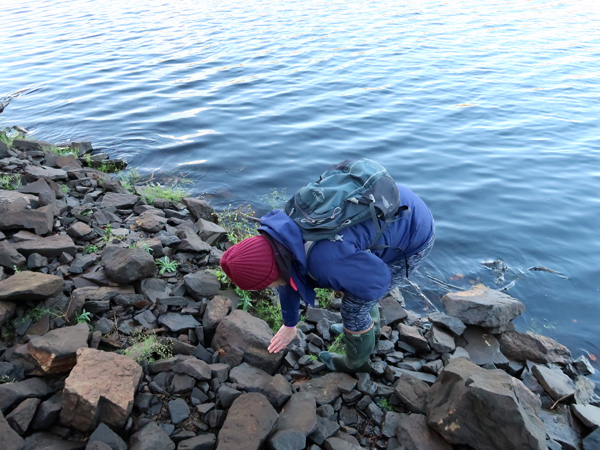
 
Searching for fossils
 
Although the water levels had since risen, we were still able to scrabble around and came across several blocks of sandstone with plant fossils in them. Palaeontology is not my strength and it was Catherine who spotted the stigmaria - the fossil root of a Carboniferous lycopod - that I took home with me but, once I got my eye in, I started to spot more of these.
 
A Carboniferous plant fossil
 
Given enough time, I am sure that we could have found many other specimens, but I was grateful enough to be shown these at the end of what turned out to be my last outing of 2022. One rock that stood out against all of the other loose pieces of sandstone was a large piece of what I think must have been ganister, which looked extremely fine grained and very siliceous.
 
Ganister with a stigmaria plant fossil
 

Tuesday, 7 May 2024

The Interior of St. Mary's Church

 
A view west along the nave from the chancel

Having looked at the Commonwealth War Graves Commission headstones in St. Mary’s churchyard in Bolsterstone with Catherine and Sally, for the Bolsterstone Graveyard Project, followed by a very quick walk around the exterior of the church, I entered the porch and immediately noticed the very coarse grained sandstone used for the door surround. 
 
The south door
 
Some of the blocks are planar bedded, with concentrations of orange iron oxides/hydroxides on the bedding planes contrasting with generally light brown colour of the sandstone and, despite its very coarse grain size, the carved head stops are surprisingly detailed. 
 
Head stops on the south door
 
Our visit to St. Mary’s church coincided with their regular coffee morning where, in addition to the usual biscuits and cakes, home-made soup is served – which was very welcome to us after wandering around the churchyard in the rain. 
 
A view east along the nave
 
I just had enough time to take a few record photographs of the principal elements of the interior - the nave, arcades, aisles and chancel – which are all designed in a Perpendicular Gothic style and the unplastered stonework gives an impression that the church is older than it actually is. 
 
The chancel
 
The octagonal columns, capitals and other mouldings to the arcades and arches are well proportioned and very pleasing to the eye and, perhaps due to the lack of wall memorials and brass plaques, the  church does not seem cluttered like many others I have visited. 
 
Views of the interior
 
I did not have the time to stop to examine the colours and textures in the stonework, which is presumably the same throughout the church and I just looked to see if there were any interesting sculpture or other details to photograph. 
 
An angel in the chancel
 
One feature of the church that brings the impression of a ‘mediaeval’ church back to its true date of 1879 are the carvings of heads above the arcade piers. The Early History of Stocksbridge and District no 15 - Bolsterstone 1 by Joseph Kenworthy states that these are the last six incumbents, from when the previous church on the site was built in 1791 to the time it was demolished and the new one built.
 
Incumbents of the church
 
 Looking closely at my photos of the carved heads, the sandstone used does not appear to be very course, as seen in the general walling and the carved angel corbel in the chancel. Next time I am in Bolsterstone, I will take another look at these and the font, about which I can find no information.

The font

Saturday, 4 May 2024

St. Mary's Church in Bolsterstone

 
St. Mary's church in Bolsterstone

During my trip to Bolsterstone in November 2022, the main reason for my visit was to help my friend Catherine with the identification of the stones used for the Commonwealth War Graves Commission headstones, as part of the Bolsterstone Graveyard Project, but I did take the time to have a very quick wander around the exterior of St. Mary’s church (1879).
 
A view of the south elevation
 
The church had already been photographed for the British Listed Buildings Photo Challenge, so I simply took a few general record photographs and, being in company, I didn’t closely inspect the sandstone from which it is built. 
 
A detail of the north aisle

Most of the stonework is quite blackened, which largely obscures the colour variations that may occur in the sandstone but, stopping to have a closer look at the north aisle, I could see that the massive very coarse grained sandstone varies from light grey brown to orange, with general iron staining and the formation of banding and Liesegang rings being a feature of the stonework where the patina and dirt have been weathered away. 
 
A detail of a window in the north aisle
 
Walking around the church at some distance, there has been some delamination of the tracery and window surrounds but, where the sandstone is laid on its natural bed, there is no scouring or pronounced decay – except in small areas beneath some of the string courses and other drip mouldings - and I didn’t see any signs of restoration. 
 
General views of the masonry at St. Mary's church
 
The rain and generally overcast sky eventually cleared to reveal blue sky, which enabled me to take a few photographs that better showed the general masonry to the south elevation, although again I didn’t get very close to the stonework. 
 
A view of the south elevation
 
The windows to the chancel have head stops, which I didn’t particularly notice on this occasion, but I did manage to use the zoom lens on my Canon Powershot G7 X Mark II to capture an angel and one of several dragons that project from the string course to the tower, which is just below the castellated parapet. 
 
An angel and dragon on the tower
 
The head stops to the porch depict a figure with either a crown or coronet and an archbishop, about which the only reference that I can find - Early History of Stocksbridge and District no 15 - Bolsterstone 1 by Joseph Kenworthy – states: ‘The corbels outside and inside the porch represent Sir Robert Rockley, Henry Bower, Archbishop of York and Richard de Westhall’. 
 
A head stop on the porch
 
Sir Robert Rockley (c.1340 - c.1415), who established a private chantry chapel in1412, and Henry Bowet (d.1423), Archbishop of York – who lived during the reign of Henry IV - have come up in my brief online search, but I am a geologist and not a genealogist and I am more interested in the provenance of the coarse gritty sandstone that has been used to build the church. 

A head stop on the porch

The Bolsterstone Graveyard Project 1

 
Catherine and Sally inspecting the headstones

Following on from my very brief visit to Sheffield on a sunny November afternoon, when I had a quick look at St. George’s church and various historic buildings during a walk back to the city centre, I had expected my next day out to be a field trip with the Sheffield U3A Geology Group to Whirlow and Ecclesall Woods – for which a recce had been undertaken earlier in the month.
 
A view of the conference room in the Natural History Museum

A change in plans led to this being postponed and replaced by a morning visit to the Yorkshire Natural History Museum in Malin Bridge, with a brief exploration of the geology and industrial archaeology along the Rivelin Valley arranged for the afternoon.
 
A view of the gallery space in the Natural History Museum
 
On the day, the rain was so heavy that the afternoon walk had to be cancelled and our ‘field trip’ consisted of a look at the main gallery, a talk on 3D scanning and a tour of the fossil preparation lab, which really didn't add much to the experience that I already had from its opening day.
 
I had to wait another week before I had my next day out – this time to Bolsterstone, a small village set above the Ewden Valley that is no longer served by buses. The occasion was to help Catherine, a friend from the Sheffield U3A Geology Group, with the identification of the stone that has been used for the Commonwealth War Graves Commission (CWGC headstones in St. Mary’s churchyard – as part of the Bolsterstone Graveyard Project.
 
Inspecting the headstones
 
Having been collected by Catherine at the Middlewood Park and Ride, we met up with Sally – a volunteer with the CWGC – and despite the rain, immediately set off to look around the large churchyard, which served surrounding hamlets that did not have their own church.
 
The headstone of private P. Woodhead
 
The first CWGC headstone that we encountered was of Private P. Woodhead of the Canadian Infantry, a regiment that I had not encountered before. The stone used is Italian Botticino marble, a Jurassic micritic limestone from Brescia, which is now used for replacement headstones. - with the regimental crest and the inscription now being cut with a CNC milling machine instead of by hand.
 
A detail of the headstone of Private P. Woodhead
 
The next headstone commemorates Marine David John Marsh of the Royal Marines, who died in 2008, which has a similar design to the CWGC headstones but has cut shoulders. Sally informed us that the CWGC only provided headstones to those who died within the core periods of WWI and WWII and that the Ministry of Defence provides for the casualties of wars outside these dates.
 
The headstone of Marine David John Marsh
 
When first seeing this particular headstone from a distance, its very pale colour immediately made me think that this was Portland stone. Getting closer to take a couple of photos, the slight cream colour – which somehow seemed odd to me - did make me wonder if it is actually made of Portland stone and I will need to take another look at it.

The headstone of Marine David John Marsh

I have a seen a lot of Portland stone over the years, when working in London as a building restoration contractor - and when photographing various civic and university buildings in Sheffield, Barnsley, Leeds and Nottingham and very many examples of post war architectural sculpture.
 
The headstone of Private G. Haigh
 
Looking at the headstones of Private G. Haigh of the Royal Fusiliers, another regiment that I hadn’t encountered, and Aircraftman A. Hodgkinson of the Royal Air Force, who died in 1919 and 1947 respectively, I immediately recognised these as being made of Portland stone.
 
The headstone of Aircraftman A. Hodgkinson
 
Once you get your eye in, the subtleties in the colours and particularly the textures become apparent and, having seen further examples of Botticino marble in the headstones of Private A. Greaves of the Labour Corps and Wren D.E. Musk of the Women's Royal Naval Service, both Catherine and Sally soon learned how to distinguish this from Portland stone.
 
The headstones of Private A. Greaves and Wren D.E. Musk
 
The headstones of Privates F. Marsh and J. Green, both of the Yorks and Lancaster Regiment, are made in the renowned Stancliffe Darley Dale stone - quarried from the Ashover Grit in the Derwent Valley to the north of Matlock. Despite the patina and algae, the light brown colour can still be seen and, without the benefit of an inspection with a hand lens or an acid test, it is easily distinguished from a limestone.
 
The headstones of Privates F. Marsh and J.Green
 
Apart from its distinctive colour, it is the abundance of shell fragments that give Portland stone its readily identifiable texture, especially when weathered and standing proud by sometimes as much as 4mm – as seen in the piers to the railings surrounding Barnsley Town Hall, which could easily be used as the starting point of a geological field trip.
 
The headstone of Sapper A.F. Stokes
 
The last headstone that I was shown was that of Sapper A.F. Stokes of the Royal Engineers, where Sally pointed out what she thought was damage to the headstone. It turned out to be a large and quite crystalline fossil cast of an oyster shell, from which part of the surrounding mould has been weathered away.
 
A fossil oyster shell
 
On the day, the weather and the very wet condition of the ground restricted us to a quick look at most of the CWGC headstones and I only took a few snaps of the churchyard as a whole, before having a walk around the exterior of St. Mary’s church. 
 
Views of the churchyard
 

Friday, 3 May 2024

Historic Architecture in Sheffield - Part 5

 
A pediment on the Cavendish Buildings

Leaving St. George’s church, having had a quick look at the building stone used in its construction, I set off back towards Sheffield city centre and stopped briefly to take a few photographs of the Mappin Building, which was built in red brick with massive sandstone dressings from 1902 to 1913, to a Baroque Revival style design by Flockton and Gibbs.
 
Views of the Mappin Building
 
The Pevsner Architectural Guide to Sheffield mentions that the eminent sculptors Frank Tory and Sons were responsible for work to the Mappin Hall in the interior and, since they were employed by the various Flockton practices for all of the carving on many of their buildings, it is likely that they were responsible for the exquisite external decoration here.
 
A detail of the Mappin Building
 
Moving down to Glossop Road, Nos. 207-215 (1906-1907) is another building designed by Flockton and Gibbs for the Birmingham District & Counties Banking Co. and comprises a bank and a row of thee shops. It is again built in brick with medium grained gritstone dressings, which could be any one of Stoke Hall, Darley Dale or Huddersfield stone – all of which are uniform in colour and texture and are suitable for ornate carving.
 
Nos. 207-215 Glossop Road

Continuing along West Street, which was widened between 1907 and 1910, there is the greatest concentration of Edwardian architecture in Sheffield, with decorative architectural faience used in several buildings that are surprisingly not listed.
 
West Street on the 1905 and 1923 Ordnance Survey maps

Nos. 252-54 West Street (1906) is one of many buildings designed for Boots the Chemist by the Nottingham based architect, A. N. Bromley. It is in a Renaissance style with a light brown faience façade, large Flemish gables and a domed cupola on the corner.
 
Nos. 252-254 West Street

Even more impressive is the Cavendish Buildings (1907) by Hemsoll and Chapman, which is built in similar brown faience and was extended in 1910 and 1919 in the same style. It was originally built as a garage and showrooms for the Sheffield Motor Company, with billiard saloons on the upper floor. Although faience buildings are not normally included in this Language of Stone Blog, the façade and the three oversized pediments are a magnificent sight in the afternoon sunshine.
 
Cavendish Buildings
 
Walking down to Devonshire Street and on to Division Street, I stopped briefly at the Water Works company offices (1867), an example of fine sandstone ashlar, which was designed by Flockton and Abbott in a Classical Revival Palazzo style - very rarely seen in Sheffield. I have never stopped to systematically photograph them, but I have always been very impressed by the carved heads on the keystones here.
 
The keystone above the entrance to the Water Works
 
Immediately next to this is the Grade II* Listed Sheffield City Hall, which I include as a stopping point when leading walks around Sheffield with the Sheffield U3A Geology Group - to look at its building stones - as it is built in the renowned Darley Dale stone, has first class stone carving by Alfred and William Tory and fine examples of British decorative stones in the interior.
 
Sheffield City Hall

On the opposite side of Barker’s Pool is the former Cole Brothers’ branch of the John Lewis Partnership, which has been a great loss to Sheffield along with Debenhams. It is now a Grade II Listed building, which I photographed for the British Listed Buildings website, but I don’t think it has great architectural merit and I continued down Burgess Street until I reached the Grade I Listed Sheffield Town Hall.
 
Sheffield Town Hall
 
Over the years, I had passed by this many times and had attended Heritage Open Days events here, to look at its interior and also with the Sheffield U3A Geology Group, but I like to stop and photograph the details whenever the light is right.
 
The clock tower at Sheffield Town Hall
 
I finished my very brief visit to Sheffield at the bronze sculpture of Thomas Boulsover, the inventor of Sheffield Old Plate, who is also commemorated by a memorial at Wire Mill Dam in the Porter Valley and the chapel at Whiteley Wood Road. Unfortunately, its Portland stone plinth is marred by the run off from the copper carbonate patina on the bronze, which nobody has tried to ameliorate by using poultices that can be quite successful on such stains.  

A sculpture of Thomas Boulsover