Tuesday, 25 January 2022

Memorials in Burngreave Cemetery

 
The Royal Army Service Cops insignia

Having photographed the lodges and chapels at Burngreave Cemetery for the British Listed Buildings website, I headed up the main path in search of the War Memorial Cross, dated 1920, which is thought possibly to be the design of Reginald Blomfield – another architect that I had never heard of before.
 
The Burngreave War Memorial Cross

Ever since undertaking photographic work for the RCHME and a brief project for the National Inventory of War Memorials at the Imperial War Museum, more than 20 years ago, whenever I encounter a war memorial I always take a photograph of it and, as a geologist with a particular interest in building stones, I am also interested to know what they are made of.
 
The Burngreave War Memorial Cross
 
In this instance it is Portland stone, which I had become very familiar with when working in the building restoration industry in London many years ago. Behind the Cross of Sacrifice is a screen wall commemorating those WWI casualties whose graves could not be marked by headstones.
 
A detail of the screen wall

On my various outings to investigate the mediaeval churches in and around South Yorkshire, I had also occasionally encountered Commonwealth War Graves in the churchyard, which were also made mainly of Portland stone. At the time I didn’t take too much notice of them but, since visiting various cemeteries to photograph the listed buildings that are often found there, I have made a point of looking for them.
 
Special Memorial headstones

I know very little about military history, but I think that the letter cutting and the regimental and insignia on the headstones provide excellent examples of craftsmanship and, as a geologist, I am always interested to see how the stone itself has weathered.
 
Special Memorial headstones

At Burngreave war memorial, there are ten Special Memorial headstones for WWII casualties who are buried elsewhere in the cemetery whose graves could not be marked. On some, the original hand cut lettering and insignias are barely discernible, with the surface of the limestone being weathered and the shell fragments standing proud.
 
A highly weathered headstone

Others look extremely fresh and sharp and, although inscriptions are reinscribed where possible, these headstones have been replaced; however, they are no longer cut by hand and the layout and cutting is now automated, using modern Alphacam Macro software and CNC machines.
 
A replacement headstone with sharp details

Monday, 24 January 2022

Architecture in Burngreave Cemetery

 
A headstop at the Burngreave Cemetery Chapel

For my next walk, a week after my exploration of the geology and archaeology of Wincobank Hill and Sheffield Board Schools at Newman Road and Grimesthorpe, I took the bus from Sheffield to the top of Spital Hill, where I photographed the Burngreave Vestry Offices for the British Listed Buildings website, before having a look at the site of the demolished Ellesmere Board School.
 
Making my way up the steep dip slope of the Parkgate Rock, I eventually arrived at the southern boundary wall to Burngreave Cemetery and followed the path down to its entrance, where I took a few photos of the Grade II Listed lodges and gate piers.
 
The lodges and main gates at Burngreave Cemetery

These were built in 1860-61 to a design by Flockton and Son, one of the architectural practices established by the eminent architect William Flockton in Sheffield, who were also responsible for the very imposing Gothic Revival style twin chapels.
 
The twin chapels in Burngreave Cemetery

I didn’t take a good look at the sandstones used here, noting only that local Coal Measures sandstone of unknown provenance has been used for the walling and more massive sandstone, from Derbyshire or West Yorkshire, for the dressings.
 
Headstops on the Burngreave Cemetery Chapels

On the front elevation, however, the surrounds to the arched doorways to the chapels on the west elevation seem to be quite gritty in nature, which I observed when taking several photographs of the headstops and other architectural details.
 
Gargoyles and figurative sculptures on the cemetery chapels

Looking up, the eaves is seen to be decorated with wolf head like gargoyles and various figurative and floriated sculptures, which are in varying condition and, up on the central tower, there are further winged grotesques and carved heads.
 
A winged grotesque on the tower

Although not obvious when seen with the naked eye, views with a telephoto lens reveal that the ashlar, which is used for the upper stages of the tower, is in quite poor condition and has delaminated in several places.
 
The upper stages of the tower

Walking anti-clockwise around the chapels, I was very interested to find that headstops or angels – one of which is playing a musical instrument - decorate nearly all of the windows; however, as with most Historic England listing descriptions, there is no mention of the materials used or the sculptors responsible for the stone carvings.
 
An angel with a musical instrument

In the latter part of the C19, Frank Tory developed a great reputation for his architectural sculpture on many of Sheffield’s finest buildings, which was continued by his twin sons Alfred and William, but most of the excellent figurative carvings that I have seen on very many Victorian churches in Sheffield seem to go unrecognised.
 
A headstop carved in coarse gritstone

At another time, I may go back and have another look at the chapels, to further investigate the stonework. Having taken plenty of photographs, I made my way up the main path, which runs along a vale underlain by the undifferentiated Pennine Lower Coal Measures Formation strata between the steeply tilted Silkstone Rock and Parkgate Rock, to look at the war memorial. 
 
The north elevation of the Burngreave Cemetery Chapels

Sunday, 23 January 2022

From Grimesthorpe to Burngreave

 
A display of stones on the forecourt of Natural Granite

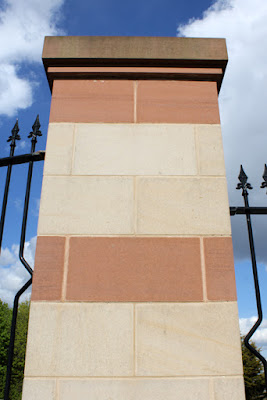
Leaving Grimesthorpe Board School, I continued up Grimesthorpe Road until I came across the Sheffield Grand Mosque, where the masonry in the boundary wall looks pristine, although the building was completed a few years ago.
 
A pier at Sheffield Grand Mosque

The bright red sandstone looks like Locharbriggs sandstone from Dumfries in the south of Scotland, with its distinctive dark streaks that frequently occur along the bedding. This early Permian sandstone is fluvial, lacustrine and marine in origin, with the deposits laid down in an arid environment that is dominated by hot deserts.
 
A general view of Sheffield Grand Mosque

The Marshalls Group owns the Locharbriggs quarry and I suspect that the buff gritty sandstone, which alternates with it in the piers, is one of the Derbyshire gritstones that they also supply – including Stoke Hall and Stanton Moor, both of which are quite similar in colour and texture.
 
A general view of Sheffield Grand Mosque

This part of Sheffield is dominated by industries that traditionally grew alongside the steel and heavy engineering works along the Don Valley in Brightside, with the upper slopes to the north side being developed with housing.
 
When planning my walk, I didn’t see any listed buildings or other points of interest worth investigating between Grimesthorpe and Brightside, so I just dropped down to Petre Street and continued my walk at a brisk pace - noting the high ground formed by the ridge of Parkgate Rock.
 
A granite clad gate pier at Natural Granite

Having walked for several hundred metres past miscellaneous businesses that occupy the various industrial units, I came across Natural Granite, a supplier of work surfaces in Sheffield and the surrounding area.
 
The premises of Natural Granite

Their painted brick premises are not particularly inviting, but the gate piers and the front wall caught my eye, with a variety of polished grey granites from their stock of 75 granites being used in their construction.
 
A granite clad gate pier at Natural Granite

Although I included a selection of granites in the now dismantled Triton Stone Library, which have been used in historic buildings and were still available in the UK 25 years ago, the identification and matching of granites is a very specialist field.
 
 A detail of the boundary wall at Natural Granite

Nevertheless, I was very curious about the various stones laid out on the forecourt and introducing myself to the receptionist, I asked if I could take a couple of photos – where I had identified Baltic Brown, the Blue Pearl and Emerald Pearl varieties of larvikite and other granites from Spain and Sardinia, as well as artificial quartz aggregates such as Silestone.

A display on the forecourt of Natural Granite
 

Saturday, 22 January 2022

Grimesthorpe

 
The datestone at Grimesthorpe Board School

Arriving at Winco Road, having briefly explored the geology and archaeology on Wincobank Hill, I was consulting my map when a local resident with her dog seemed to sense my temporary loss of direction and asked if I needed help.
 
The memorial to William Batty

For the second time on my walk to date, I ended up deep in conversation and, when we had finally finished, I carried down Wincobank Lane where I came across a monument to William Batty in the form of a Peterhead Granite obelisk – a memorial left from the Methodist church burial ground that once existed here.
 
An outcrop of Parkgate Rock

At the bottom of the road, at the rear of an area of cleared buildings that is now used for parking, I encountered a substantial outcrop of steeply dipping sandstone, which I assume relates to the quarries that once used to operate here.
 
Interbedded sandstone and mudstone
 
The lowest beds are of quite massive sandstone, which are overlain by a bed of mudstone that passes up into another bed of sandstone, which appears to be much less competent. At the time, I just assumed it to be another example of the Silkstone Rock and didn’t think of collecting a specimen; however, I now realise that, when deviating from the path down Wincobank Hill, I had crossed onto the Parkgate Rock.
 
The Wesleyan Reform Church on Upwell Street
 
On Upwell Street, I stopped to take a few general record photos of the Wesleyan Reform Chapel, dated 1887, although I didn’t stop to take a good look at its stonework, which is highly blackened and doesn’t display its physical characteristics well.
 
The east elevation of Grimesthorpe Board School
 
Continuing along Grimesthorpe Road to Earl Marshall Road, I arrived at the Grade II Listed former Grimesthorpe Board School, dated 1875 - the twelfth commissioned by the Sheffield School Board and which had all been designed by the architects Innocent and Brown.
 
A general view of Grimesthorpe Board School

As was a characteristic feature of their work, they designed the building to make the most of the sloping site and here they devised a two storey building, with a basement, in the Gothic Revival style. This is considered to be one of their more striking designs, being French in character and more dramatic than their usual English Domestic Gothic designs.
 
The caretaker's house

The school originally had 757 places, to serve a village heavily involved in scissor making and grinding, but was later expanded slightly, with a caretaker’s house built in 1877 and minor alterations and extensions increasing the number of pupils to 820 by 1889.
 
A general view of Grimesthorpe Board School
 
Compared to their earlier schools at Carbrook, Walkley and Darnall, there is less architectural ornament, but there are still examples of their trademark details – including a soaring bellcote, herringbone stonework, trefoils and a datestone that includes the school board crest.
 
A detail on the east elevation of Grimesthorpe Board School

I didn’t have a close look at the stonework, although its uniform buff colour and texture would seem to suggest that Crawshaw Sandstone has been used again for the walling, voussoirs, string courses and other relatively small masonry sections. As for the dressings, massive sandstone seems to have been used only for the larger sections, which I assume to be the favoured Stoke Hall stone from Derbyshire.
 
The south elevation of Grimesthorpe Board School

Thursday, 20 January 2022

Geology at Wincobank Hill

 
A specimen of Silkstone Rock from Wincobank Hill

On the LIDAR map, the ridge of Silkstone Rock upon which Wincobank Iron Age Hillfort is set is clearly visible, with its ramparts effectively occupying the whole summit and overlooking steeply sloping ground on either side.
 
A LIDAR map of Wincobank Hill

Continuing my walk down towards Wincobank Wood, most of the views to either side of the ridge were largely obscured by trees but, before long, the ridge narrows markedly and the steep sided slopes are easy to see from the path.
 
Silkstone Rock exposed along the path

In the well worn path, the occasional rocky projection soon turns into small but distinct sheets of flaggy sandstone of no great durability, which outcrop beneath and around the path for a considerable distance along the ridge.
 
Steeply dipping strata

This extensive exposure of Silkstone Rock was completely unexpected and, everywhere I looked, there were obvious signs of the presence of the Don Monocline, with the strata marked on the British Geological Survey map as dipping as much as 30 degrees to the south-east.
 
A broad expanse of Silkstone Rock along the path

The sheets of flaggy sandstones are pervaded by irregular jointing, which is often quite small in scale and breaks the rock into fragments that are easily weathered and eroded, both by the elements and the walkers that traverse the path.
 
A detail of the Silkstone Rock

In several places, I stopped to take photographs of the various outcrops but I found it very difficult to capture the nature of the landscape that I could see around me or the steepness of the slopes just to either side of the path.
 
Steeply dipping Silkstone Rock

I collected a few samples from different places along the path, which steepens noticeably to the south-west and these are all fine grained and grey/light brown in colour, with iron staining where the sandstone has weathered along the joints.
 
Specimens of Silkstone Rock from Wincobank Hill

The larger sample, taken from one of the more competent beds, has well developed laminations that are rich in iron oxides/hydroxides and, although I saw no nodules of ironstone anywhere, iron slag has been found near Wincobank Hillfort and geophysical evidence suggests that ironworking may have taken place in the fort itself.
 
A specimen of Silkstone Rock from Wincobank Hill

In post-medieval times, Wincobank Wood was worked for the coal and ironstone that occurs beneath the Silkstone Rock, as seen at nearby Kimberworth, along with charcoal burning and the production of white coal.
 
A panoramic view from Wincobank Hill
 
Stopping briefly to admire the panoramic views over north-east Sheffield, I continued down the path to a way marker, where I was curious to see directions to a place called Sandstone. Here, I met a couple who knew the area well and we talked for ages about the area around Wincobank Hillfort, before I set off to Grimesthorpe.
 
A waymarker