Friday, 15 December 2023

Notre Dame High School in Ranmoor

 
A general view of Oakwood

When approached by the Ranmoor Society to give an illustrated talk on the historic architecture of Ranmoor, with particular emphasis on the connection with the local geology, I was asked if I might be able to include places like Endcliffe Hall, Tapton Hall and Oakbrook – once owned by the steel magnates John Brown, Mark Firth and Edward Vickers respectively.
 
A History of Notre Dame High School
 
Endcliffe Park is a military site and is inaccessible to the general public, but I did manage to visit Tapton hall and after my guided tour of Ranmoor with Gerald Eveleigh, the society secretary, I popped into Notre Dame School to ask if it would be possible to have a look at the exterior of Oakwood, now the 6th form block, before the school summer holiday ended. 
 
The west elevation

In the last week in August 2022, following up my day out to Hickleton and Doncaster, the deputy headmistress showed me around the exterior of the Grade II Listed house (c.1855), designed in an Italianate style by Flockton, Lee and Flockton. 
 
The porch

The owner, Mark Firth, was one of the most important steel manufacturers and philanthropists in Sheffield in the C19 and became the Lord Mayor of Sheffield and the Master Cutler. The porch was added in 1875 by Flockton and Abbott when the Prince and Princess of Wales visited as Firth’s guests on a visit to the city. 
 
A balustrade marking the position of the Oak Brook
 
Approximately 200 metres to the north of Oakbrook, the Oak Brook rises from the junction of the Rough Rock and underlying mudstones, before flowing south and being culverted under Fulwood Road and then re-emerging in the grounds of Oakwood, where this marked by a balustrade. 
 
The burial ground for the nuns of the Sisters of Notre Dame
 
After being purchased c.1894 by W. S. Laycock, the house and grounds were sold in 1919 to the Roman Catholic Sisters of Notre Dame, who had been invited to England in 1845 to teach and had moved to the St. Vincent's district of Sheffield by 1855. The school that was founded was soon moved here and eventually a small area of was set aside as a burial ground for the nuns who worked, lived and died here. 
 
The south elevation
 
Moving back to Oakwood, I had a quick look at the medium grained sandstone that has been used in its construction. It has a very uniform slightly yellow colour and there is no obvious iron staining and it has a very even texture, which to me suggests that it might be Huddersfield stone, which became available in Sheffield after the Huddersfield and Sheffield Junction Railway opened in 1850.
 
Ionic capitals on the porch
 
The sandstone ashlar is still in very good condition, as are the carved details to the porch, which has a dentilated cornice and Ionic capitals. I didn’t spend any time examining the stonework and just walked around the building at a distance.
 
The west elevation
 
Except for the later porch, the only elaborate carving on the building is on the surrounds to the south doorway and its round arch, with a head carved on its keystone, and the first floor window surrounds above, which has elaborately carved corbels that incorporate animal’s heads. 
 
A detail of the south door

Having taken enough photographs of the exterior to illustrate my forthcoming talk, I was taken inside to one of the offices and given a couple of copies of A History of Notre Dame High School. Here, I took a record photo of a fine marble fireplace, which I presume is just one of many found in the interior of the house.

A marble fireplace

An Afternoon in Doncaster

 
A Norman window head

Arriving in Doncaster on the X19 bus, having had a good look at St. Wilfrid’s church, the historic architecture and Castle Hill Quarry in Hickleton, before doing a bit of shopping, I decided to have a quick look at the new Danum Gallery, Library and Museum (DGLAM).
 
The Danum Gallery, Library and Museum
 
Over the years, I had visited the old museum on Chequer Road many times and passed by the Doncaster High School for Girls (1910), built in red brick with terracotta dressings, which I can only ever remember as an empty building. Although not listed, I have always thought that it is an interesting building, but feared that it would eventually be demolished. 
 
The retained facade and glass enclosure

I was therefore very pleased to learn that the facade would be retained and form part of the new building, which is sited next to the modern complex on Watergate that contains the Savoy cinema, the Cast theatre and the Doncaster MBC offices; however, I was unaware that the old facade was to be enclosed within a glass frontage and, approaching from Hallgate after photographing No. 27 for the British Listed Buildings website, I was quite surprised when I saw it. 
 
The geology display
 
Having known well the ‘modernised' museums in Sheffield, Rotherham and the Chequer Road museum in Doncaster, I was interested to see how the geology display in particular compared to its predecessor, especially since the new galleries occupied a considerably reduced floor space. 
 
A fossil tree trunk from Hickleton Colliery
 
Disappointingly, as with Sheffield and Rotherham, the geology displays have been severely downgraded, with only a single large display case dedicated to this once highly appreciated science. These include a fossil tree trunk from the Upper Carboniferous period, fossil plants embedded in grey siltstone, coal and a Permian dolomitic limestone block containing a large plant, which is thought to be related to the monkey puzzle tree. 
 
A fossil in dolomitic limestone from Hampole Quarry

In addition to the Carboniferous and Permian specimens, the Triassic period is represented by a section of a drill core from Austerfield pumping station, which is a red sandstone from the Sherwood Sandstone Group – an important aquifer in the Doncaster region. 
 
A Triassic sandstone drill core

The highlight is probably the Jurassic fossil ichthyosaur from Lyme Regis in Dorset, which was originally thought to be a plaster cast from a specimen elsewhere. In 2008, it was identified by Dean Lomax, who has since become a specialist in the subject, as a new species – Ichthyosaurus anningae. 
 
Ichthyosaurus anningae
 
I can’t recall much about the archaeology displays at the Chequer Road museum and I was therefore interested to see the display case containing the shaft of an Anglo-Saxon cross, with Celtic style knot work, a large fragment of a wheel cross and a Norman window head. 
 
An archaeological display
 
Very strangely, there are no labels to describe these and many of the other museum specimens, with digital technology apparently being used instead; however, the gallery attendant on duty was unable to shed much light on these and I moved on without knowing anything about the interesting artefacts that I had just looked at. 
 
A Roman altar stone

The Roman occupation of Doncaster is represented by an altar stone, which is one of the earliest finds of the period, but the only other exhibit that really appealed to my particular interests in stone in all of its forms was the model of Conisbrough Castle. 
 
A model of Conisbrough Castle

The 45 minutes that I spent having a quick look at DGLAM wasn’t enough time to judge its merits as a whole, but I was conscious of the need to get to Doncaster Market before catching a train to Rotherham, on my way back to Treeton. 
 
A Rich Seam by Laurence Edwards
 
I stopped briefly to take a few photographs of a sculpture on Printing Office StreetA Rich Seam by Laurence Edwards – which is constructed with two 25 tonne large rough-hewn blocks of Crosland Hill sandstone, with inset bronze sculptures of the faces of miners who worked at the coalface in Doncaster. 
 
Bronze heads depicting former coal miners
 
This example of public art in Doncaster, one of many that has been erected in the last 25 years, received very mixed reactions when it was completed in 2021. Personally, I preferred the artwork that previous occupied the site – various carved seats depicting local history and nursery rhymes by Mike Disley – but these had become seriously damaged or vandalised over the years.
 
A detail of A Rich Seam

Tuesday, 12 December 2023

Castle Hill Quarry in Hickleton

 
Yellow dolomitic limestone at Castle Hill Quarry

When setting out to photograph Castle Hill Farmhouse, during my exploration of the historic architecture of Hickleton, I had a wander around Lady Mary View to see if I could get a good view of the old quarry face to Castle Hill Quarry, which borders the back gardens of several houses on the modern housing estate. 
 
Back in 1997, I had briefly visited the estate when undertaking surveys of potential RIGS (Regionally Important Geological Sites) in Doncaster and recorded the presence of sandy brecciated beds, which had been eroded to leave a distinct overhang. 
 
An old quarry face at Castle Hill Quarry

On this occasion, I couldn’t see much of the quarry face from the roadside but, when my curiosity led me down a path that I found on Lady Mary View, I could see a section of massive limestone in the Wetherby Member of the Cadeby Formation. 
 
A section through the Wetherby Member of the Cadeby Formation

The outcrop of the Cadeby Formation here forms a distinct elongated spur, which would have made it an obvious location to quarry building stone. Making my way further along the path, I soon came to another part of the quarry face where the section mainly comprises beds of massive limestone, with thinner beds in its upper parts. 
 
A rift in the quarry face
 
A little further along the quarry face, I came across a well developed rift in the rock face, of  a type that I had seen before along the Don Gorge and at Barnburgh Crags, when undertaking the Doncaster Geodiversity Assessment back in 2007. I didn’t take the time to examine it closely, but I didn’t see an infill of Quaternary sand and gravel, which is commonly associated with these rifts and often contains the bones of mammals. 
 
A section showing differentially weathered sandy beds

In the upper part of the exposed quarry face, the massive limestone is overlain by a very sandy bed that is orange in colour and is differentially weathered. Further along the quarry face, the yellow/orange sandy limestone is much thicker and, as shown by the development of scouring and cavities, is much less resistant to weathering than the typical buff coloured dolomite. 
 
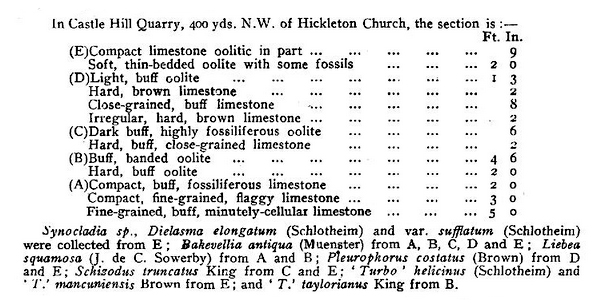
A section recorded in the geological memoir
 
The geological memoir records a 7 metre section, which describes the limestone as mainly oolitic, with variable grain size, texture and colour and mentions that various bivalves, brachiopods and bryozoans have been found; however, it makes no mention of the yellow to orange colour variation of the softer beds, which I immediately noticed. 
 
A section through the quarry face showing various lithologies
 
Although I did not have my Estwing hammer with me, using a large lump of stone that was lying on the ground, I managed to obtain a small sample from one of the thin beds. The body of the stone is buff in colour with yellow colouration on the bedding planes. Its texture is dense and finely granular, without the voids or vughs seen in the sample taken from the wall alongside Barnsley Road and it also contains black specks that are probably a manganese oxide mineral.
 
A specimen of dolomitic limestone taken from Castle Hill Quarry

The distinct yellow colouration of the Cadeby Formation usually occurs only at exposures where the limestone is seen to rest on the Yellow Sands Formation, which are regarded as the local remains of aeolian deposits filling hollows in the pre-Permian landscape. 
 
A section of sandy limestone
 
The Yellow Sands Formation is not marked on the geological map of the area around Hickleton, although it does occur along the Magnesian Limestone escarpment as a small outcrop 5 km, to the south-east at High Melton, with more extensive exposures 1 km to the north at Bilham Sand Pits and Watchley Crags. 
 
The archaeologist J.R. Magilton, quoted on p.37 of the Doncaster Character Zone Descriptions section of the South Yorkshire Historic Environment Characterisation project, considers that Castle Hill Quarry is “perhaps contemporary with the estate village”, which would date it to the C17 rather than the C12, when St. Wilfrid’s church was built. 
 
St. Peter's church in Barnburgh
 
Although I have seen several churches that incorporate some yellowish limestone, St. Wilfrid’s church and particularly St. Peter’s church in nearby Barnburgh, are the only churches in South Yorkshire that are built entirely with yellow limestone. This raises the question of the quarry source of the limestone used to build the churches and the historic buildings in these villages.
 
A section of the Cadeby Formation at Barnburgh Crags
 
When visiting Barnburgh Crags, also whilst undertaking the Doncaster Geodiversity Assessment, I was struck by the yellow colour and I thought that the crags had been quarried at its eastern end, at least. The Historic England Building Stones of England map, which is based on the up to date British Geological Survey maps, does not show any quarrying here but it does highlight the Hickleton Quarry, which supplied stone to the Hickleton Hall estate. 

An extract from the Historic England Building Stones of England map

Sunday, 10 December 2023

Historic Architecture in Hickleton - Part 2

 
The Forge

When I arrived in Hickleton on the bus from Barnsley, I couldn’t see any modern buildings along the main road and, walking back down to the triangular green after looking at St. Wilfrid’s church, I still didn't see any as I headed up towards Castle Hill Fold. 
 
Vernacular architecture in Hickleton
 
Hickleton essentially grew as the estate village to Hickleton Hall and looking at the 1854 and 1949 Ordnance Survey maps, the village changed very little during a period of nearly 100 years. Most of the buildings marked on the 1854 map still exist and, according to the Hickleton Village website, further developments didn’t commence until the 1960’s. 
 
Ordnance Survey maps of Hickleton from 1854 to 1949

Having encountered several agricultural and domestic buildings, constructed in yellow dolomitic limestone with stone slate eaves to a red pantile roof, the first modern houses I saw were on Castle Hill Fold, where a small estate has been built. 
 
Castle Hill Farmhouse

The Grade II Listed C17 Castle Hill Farmhouse, which was extended in the mid C19, is built with the same materials but, with it being set back from the road, I could only get a partial view of it and after taking just a couple of photos I cut through a nearby snicket to Lady Mary View. 
 
A map of Hickleton Conseration Area showing its Listed Buildings
 
The entire village falls within the boundaries of the Hickleton Conservation Area and all of the modern buildings are built in stone, with red pantiles and, quite surprisingly, stone slate eaves. The various houses are set back from the road and often partly obscured by stone walls, trees and hedges and at the time I didn’t take much notice of these, being more interested in the quarry face that I could see in some of their back gardens. 
 
Houses on Lady Mary View

When looking at one of my photos and using Google Street View to try and locate the path that I took to Castle Hill Quarry – to be described in my next post – I can see that the stone used to build the new houses is not dolomitic limestone, which would be expected and was obtainable at the time when they were built, but is actually sandstone. 
 
A crucifix erected by the 2nd Viscount Halifax
 
Retracing my steps back to Barnsley Road, I then headed down to Lidgett Lane to continue my investigation of the historic architecture in Hickleton and to further photograph its listed buildings. At the junction with Doncaster Road, I came across what may be a former buttercross, upon which was erected another crucifix by the 2nd Viscount Halifax  – the 6th that I had seen in the village. 
 
Nos. 41-42 Lidgett Lane
 
Nos. 41-42 Lidgett Lane are a pair of houses that probably date to the early C19, which are again built of limestone with a red pantile roof and a stone slate eaves course. It is largely obscured by boundary hedges but, with it being listed for group value only, I just took a few general photos and moved on to Nos. 37-40, which are dated late C18 to early C19. 
 
Nos. 37-40 Lidgett Lane

The Forge, as its name suggests, was formerly the village smithy and probably dates to the early C19. Perhaps reflecting its commercial rather than residential use, it is built with limestone rubble rather than squared and coursed masonry, which is seen in most of Hickleton’s historic buildings. 
 
The Forge
 
Nos. 34-35 Lidgett Lane are a pair of cottages that probably date to the early C19, but don’t have any particular architectural merit except to add to the general character of the village, with its further use of deeply coursed and squared masonry, red pantiles and stone slates.
 
Nos. 34-35 Lidgett Lane

Moving back on to Doncaster Road, Nos. 30-33 Lidgett Lane, formerly listed as being on Village Street, are a terrace of four cottages that are dated probably to the C17 but have been heightened in the late C18 or early C19, which can be clearly determined by the change to large squared blocks on the first floor. 
 
Nos. 30-33

Crossing over Doncaster Road, I made my way up Fir Tree Close to Home Farm Court, both of which are modern housing developments. Being conscious that residents seem to be very wary of anyone taking photos around their houses, I just took a few quick snaps of Home Farm Court, dating back to the C17 with C18 and C19 additions, along with the nearby dovecote. 
 
Home Farm Court and the dovecote

Returning to Doncaster, I walked back up the escarpment until I reached the Old School, which Historic England date as probably being C17, with later additions. Views of the house were partially obscured by boundary hedges but, photographing it from an oblique angle, I could see its principal features and the usual building materials. 
 
The Old School

I had spent 3 hours exploring Hickleton and it was not yet 2 o’clock in the afternoon, so I decided to take the next X19 bus to Doncaster. While waiting at the bus shelter, which is incorporated within an old agricultural building, I couldn't help but notice the severe deterioration of the yellow limestone from which it is built.
 
A detail of deteriorating dolomitic limestone