Saturday, 14 July 2018

The Building Stones of Sheffield - Part 2


Fluvio-glacial cobbles at Sheffield Cathedral

After Sheffield Central Library, the next stop on the U3A Sheffield Geology Group field trip to Sheffield city centre was at the adjoining Tudor Square, where there are several large Crosland Hill sandstone planters designed by the artist Stephen Broadbent.

A large Crosland Hill sandstone planter in Tudor Square

Three hand-made plaster maquettes produced at 1:10 of the size of the final sculptures were laser scanned in Liverpool and each of the 173 individual stones were then carved at their full size by a robot at Johnsons Wellfield in Huddersfield, before being carefully assembled together.

An extract from the Building Stones of Sheffield - by Peter Kennett

Moving on to Fargate via Chapel Walk, the group then had a quick look at some of the various stones that were used during the remodelling of Sheffield’s main shopping street back in 1998. These include Spanish and Portuguese granite setts - laid by a gang of paviour masons from Naples - Caithness flagstone and Red Lazonby sandstone, with the latter showing considerable signs of wear and physical degradation. 

Grotesques on the gate posts in the forecourt of Sheffield Cathedral

Crossing Church Street from Fargate, we stopped at the gate posts on the corner of the cathedral forecourt - to appreciate the elaborately carved grotesques - before examining the coarse locally quarried Rivelin Grit, which has been used for Sheffield Cathedral and the Employment Tribunals Service building on East Parade. 

The statue of James Montgomery

The plinth to the James Montgomery statue in the old churchyard provides an example of Cornish grey granite, which was formed during the Hercynian period of mountain building - like the granites from the Iberian peninsular used on Fargate - but its colour and well formed feldspar crystals give it a very distinctive character. 

Examining the alabaster tomb at the rear of Sheffield Cathedral

To the rear of the cathedral next to Campo Lane, an alabaster tomb that was formerly sited inside the cathedral was moved to its current location in the 1960’s and, being soluble in rainwater, has subsequently disintegrated at an accelerated rate – with fractures in the stone being extensively weathered and its surfaces deeply furrowed. 

Historic buildings on St. Paul's Parade
 
The morning session was finished with a brief look at St. Paul’s Parade, where Browns brasserie provides a good example of Triassic Red St Bees sandstone, and a good look at the sandstones, granites and volcanic green slate that have been used in the Goodwin Fountain, which forms the centrepiece of the Peace Gardens.

Various stones used in the Goodwin Fountain

Here, as in Fargate, not all of the stones used have fared well after nearly 20 years of wetting and drying and, in winter, freezing and thawing. The Permian Clashach sandstone, in particular, has deteriorated to the extent that much of it really needs to be replaced – something that I suspected after I observed its very variable mineral content, when reporting on the project for Natural Stone Specialist soon after it was finished.

A detail of the Goodwin Fountain in Sheffield Peace Gardens

Tuesday, 10 July 2018

The Building Stones of Sheffield - Part 1


A general view of Sheaf Square

After a few months of relative inactivity since visiting Eyam in October 2017, the new year got off to a good start with a talk to Aston-cum-Aughton History Group followed by a walk in Sheffield city centre a couple of days later, to look at its building stones with the Sheffield U3A Geology Group

The Building Stones of Sheffield

The itinerary for the field trips in 2018 had been discussed at the indoor meeting at the Commercial Inn in January and when I mentioned that I had been consulted as a ‘building stone specialist’ for the production of the “Building Stones of Sheffield” leaflet - which was suggested as the basis for a possible field trip - I was immediately delegated to lead this. 

A report on Fargate for Natural Stone Specialist

Having developed stone identification and matching skills, when setting up Triton Building Restoration Ltd. in London back in 1989, and having written several articles for various stone trade magazines in the UK and Germany – which described developments on Fargate, the Peace Gardens, Tudor Square, The Moor and Sheaf Square – this suited me down to the ground. 

Allen the Peregrine outside Sheffield Midland railway station

On a damp February morning, we convened at the ‘Allen the Peregrine' sculpture in Sheaf Square, where we could appreciate the topography formed by the Silkstone Rock here, and looked at the sandstones used to build the Sheffield Midland railway station and the cascades and fountain. 

Chinese 'granite' paving in Sheaf Square

We then headed up into Sheffield following the 'Gold Route' from Sheaf Square to Tudor Square via Howard Street – where various dark ‘granite’ from China has been used for the paving – and on the way we paused to have a very good look at Sheffield Central LibraryOpened in 1934, this Portland limestone clad steel framed structure is my favourite historic building in Sheffield, with fine examples of sculpture by Alfred and William Tory.

A view of Sheffield Central Library from Arundel Gate

To the elevation facing Arundel Gate, various cracks can be seen in the white glazed bricks and walking around the publicly visible parts of the building, there is plenty of evidence of a rusting steel frame and, in places, the stonework needs to be cleaned.

The main entrance to Sheffield Central Library

The medallions carved around the main entrance represent Literature, Music, Drama, Architecture, Sculpture, Painting, Mathematics, Chemistry and Astronomy and, high up on the splay, an Egyptian style motif depicts Knowledge. 

A general view of Sheffield Central Library

Unlike the sandstones that have been used for most of the historic buildings in Sheffield, the Portland limestone here has been very susceptible to the industrial pollution, which was once a big environmental problem in Sheffield; however, although this has resulted in the loss of a few millimetres of the surface of the limestone, this reveals an abundance of fossil oyster shells.

 A detail at Sheffield Central Library

Sunday, 8 July 2018

"Rotherham Red" on the X54 Bus Route


The trip to Eyam with the Sheffield U3A Geology Group proved to be my last day out in 2017 and the winter was spent catching up with the writing of brief reports on the places that I had visited since starting my investigation of St. Helen’s church in Treeton back in February 2016, which had turned into an intensive exploration of the mediaeval churches in South Yorkshire and the surrounding counties. 

St. Helen's church in Treeton

I had been inspired by an encounter with Elmet Archaeological Services Ltd. in Wath-upon-Dearne, who used the nearby All Saints church to provide an introduction to standing buildings archaeology, and having previously worked for archaeologists at All Saints church in Pontefract and Brodsworth Hall – for a pre-restoration survey and a contribution to the Conservation Plan respectively – I thought that my experience made me suitable for undertaking this kind of work. 

The interior of St. Helen's church in Treeton

When the Aston-cum-Aughton History Group contacted me from the Sheffield libraries database to ask me to give a talk, I immediately thought of the investigations of the mediaeval churches in Treeton, Aston, Todwick and Harthill that I had undertaken in this part of Rotherham on the X54 bus – all of which lie on the red coloured Mexborough Rock, which is known locally as Rotherham Red sandstone. 

All Hallows church in Harthill

As an introduction to the geology, building stones and construction history of the medieval churches found within a short distance of the village of Aston, this talk went down very well with the full house and, on the strength of this, I have since been invited by one of the attendees to give a similar talk to the Friends of Rotherham Archives at Clifton Park Museum next year. 

The church of St. Peter and St. Paul in Todwick

In addition to the numerous illustrated talks and guided walks that I have delivered to various local history and conservation groups in South Yorkshire, I have also taught formal courses for the WEA in Rotherham and Sheffield and for Sheffield University adult educational services. 

All Saints church in Aston-cum-Aughton

At Beauchief Abbey, I encountered a group of archaeology students from Sheffield University – whose group leader sought my advice on their finds – and various vicars, churchwardens and architects have also expressed great interest in the work that I was doing. For professionals who need to undertake Continuing Professional Development courses and seminars, perhaps they could also learn a thing or two from me?


Thursday, 28 June 2018

A Geology Field Trip Around Eyam


Gigantoproductus brachiopod fossils in the Lower Shell Bed

I once lived in Bakewell and got to know the geology of the Peak District National Park quite well when I was commissioned to survey its RIGS (Regionally Important Geological Sites) and to identify places where tourism could be diverted away from ‘honeypots’ like Castleton.

A geological map of the area around Eyam

A month of intensive work only scratched the surface of its geology, but I nonetheless encountered a wide variety of sedimentary and igneous rocks and many spectacular landforms that I would recommend to prospective visitors to the Peak District.

Rose and Fossil Cottage

When I joined the Sheffield U3A Geology Group, I was very impressed by the wide variety of field trips that they undertook and, currently being without a car, it provided an opportunity to visit places that were otherwise inaccessible to me.

The Lydgate Graves

The October 2017 field trip to Eyam particularly interested me. Best known to tourists as the “plague village”, due to the part it played in containing an outbreak of the bubonic plague in 1665, there is also some interesting geology and geomorphology. 

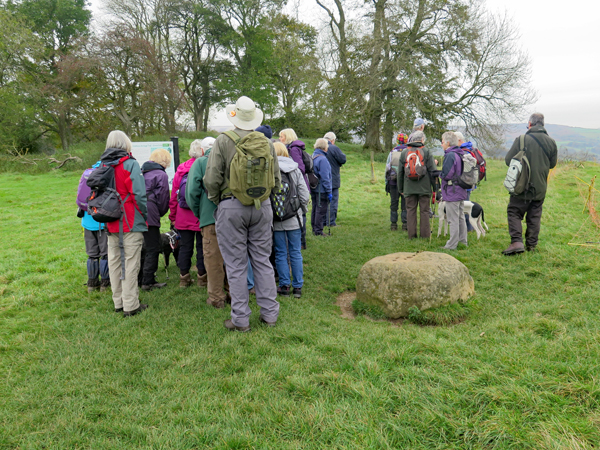
Gathering around the information board at the Boundary Stone

The village is set on the Bowland Shale Formation, the lowermost strata of the Upper Carboniferous, and we started off here by looking at two of the very many places associated with the plague – Rose and Fossil Cottage and the Lydgate Graves. Making use of the Heritage Trails produced for the area around Stoney Middleton, we then followed a distinct ridge formed by the Eyam Limestone Formation to see the Boundary Stone

A view of Upper Carboniferous rocks from the Eyam Limestone ridge

From here, the younger Upper Carboniferous sandstones and siltstones rocks can be seen to form an escarpment to the north and, to the south, the flat reef limestone on which we were standing passes down into the Monsal Dale Limestone, which is seen in Middleton Dale

Lover's Leap in Middleton Dale

To the south side of Middleton Dale, the Monsal Dale Limestones have been extensively quarried and evidence of lead mining, lime kilns and evidence of other industries that have exploited the geological resources can be found along the gorge.

The Stoney Middleton Heritage Trail

The vertical cliff faces on the north side of Middleton Dale, especially at Castle Rock, show a cross section through the Eyam Limestones and the Monsal Dale Limestones, with variations in the facies, and differences between shallow and deeper water sediments can be clearly seen.

Castle Rock

Variations in colour and texture can be seen on a large scale and certain geological horizons such as the Lower Shell Bed in the Upper Monsal Dale Beds, where Gigantoproductus brachiopods can be found in great numbers, are quite spectacular. 

The Lower Shell Bed

In places, the path along Middleton Dale is quite precipitous – and not followed by everyone - but there are good examples of fluorite mineralisation, colonies of corals and fine views across to the quarries on its south side. 

A coral colony

Leaving Shining Cliff to walk back up to Eyam, the B6521 follows the course of a heavily wooded dry valley, and just before re-entering the village there is an exposure of thick beds of chert in the Eyam Limestone Formation - the last stopping point at the end of a very interesting day.

An examination of Eyam Limestone containing beds of chert

Thursday, 14 June 2018

In Harrogate


A war memorial in Harrogate

When planning the weekend away to Knaresborough, it was always my intention to visit on the same weekend as The Flooring Show, a national trade exhibition held annually at the Harrogate Convention Centre. Although I had only a passing interest in this event, to see if there were any potential uses of my Glowing Edges Designs for rugs and carpets, I mainly wanted to have a good long wander around Harrogate

Bettys Cafe Tea Rooms

Very many years ago, I drove through this old spa town and noticed that it contained numerous large and ornate Victorian buildings and I was interested in having a closer look. Being dropped off at Harrogate railway station with my travel bag, I only had a fleeting look at some of the buildings on the way to and around the convention centre, but it was enough to give me an introduction to its building stones

The geology of the area around Harrogate

Most of the low lying old town centre is built on the Bowland Shale – potentially the source of shale gas by the controversial process of fracking - but the area surrounding Harrogate is formed from the Millstone Grit Group, which is usually a source of good quality building stone; however, in this part of Yorkshire and further north, the Yoredale Group forms a very distinct local variation in the character of these Carboniferous rocks, with limestone alternating with siliceous rocks. 

The Wesley Chapel in Harrogate

I didn’t get the opportunity to examine any of the buildings closely using my hand lens and other geologist's tools that I had with me - to determine the physical characteristics of the stones - but buff/brown sandstone is ubiquitous in the historic buildings of Harrogate. 

The Victoria Shopping Centre

Opposite the railway station, the Victoria Shopping Centre, built in 1992 by architects Cullearn & Phillips in a Palladian style, caught my eye – not least for the statues at parapet level and the colour of the stone, which is distinctly orange/red in places and not typical of those normally quarried from the Millstone Grit. 

The Jubilee Memorial

The ornate sandstone Jubilee Memorial of 1887, with a Portland limestone statue of Queen Victoria, is very impressive and makes use of Scottish grey and pink granite in its columns – materials that were widely used in the late 19th century, but are now generally unobtainable and difficult to match

A relief sculpture on Harrogate War Memorial

Another use of Portland stone can be seen in the Harrogate War Memorial, but around Low Harrogate, where the original spa town grew around the various springs that are found here, sandstone dominates the historic architecture. 


A detail of the pediment to the Royal Hall

Although I had no opportunity to closely examine them, the large monumental buildings such as the Royal Baths and the Royal Hall appear to be built of stone with a uniform colour but commercial parades and the less ornate buildings have greater orange/brown colour variation.

Cheltenham Parade in Harrogate

I have never had a reason to professionally investigate the geology and building stones of North Yorkshire, and haven't visited any quarries there, but I suspect that the grand buildings have used sandstone from West Yorkshire – given its reputation for producing durable stone - and those of lesser importance have used the cheaper stone from nearby.

The Royal Baths in Harrogate

Like Buxton in the Peak District, although it would take a long day out to get there and back by public transport, I think that I could easily spend a few hours exploring its historic architecture - as well as its green spaces - and I look forward to visiting Harrogate again.


Tuesday, 12 June 2018

The Nidd Gorge


The geology around Knaresborough

Compared to 2016, when I got on the bus and train to travel as far as I could from Treeton – to survey a wide variety of mediaeval churches and associated historic buildings – 2017 was a comparatively quiet year.

Knaresborough railway station

I had explored parts of the Sheffield Round Walk and the villages of Norton and Grenoside, as well as having a close look at the Mam Tor landslip, but I spent most of the time much nearer to home – helping out with the maintenance of St. Helen’s church and trying to get another Glowing Edges Designs project off the ground.

A view of the railway viaduct in the Nidd Gorge

It had taken 15 years for an idea for a display at Clifton Park Museum to turn into the production of a set of unique Crepe de Chine silk scarves and I was in need of a break – which was provided by the offer from an old friend to spend the weekend in Knaresborough.

A view along the Nidd Gorge from the A59 road bridge

Arriving on the train across the viaduct from Leeds, I didn’t really notice the Nidd Gorge which, along with Knaresborough Castle and Mother Shipton’s Cave, is one of Knaresborough’s principal tourist attractions; however, with the plans to spend an afternoon in Harrogate cancelled, I was shown around this very attractive place. 

A cliff on Waterside

Walking down Waterside to the river from the road bridge on the A59, I didn’t stop to investigate further as I would have done if I were not in company and, even when passing under the railway viaduct, I didn’t take much notice of the surrounding gorge – until I encountered the vertical cliff face upon which the castle is set.

Magnesian Limestone above the Addlethorpe Grit

Knowing the Magnesian Limestone very well - based on geological surveys in South and West Yorkshire, I immediately recognised the pale limestone of the Cadeby Formation high up in the cliffs. Beneath this, I assumed that the red/orange cross bedded sandstone was a thick deposit of the Yellow Sands Formation - which I had seen before in Hooton Pagnell and Pontefract.

Sandstone in the Nidd Gorge

I have since discovered that this is actually the Addlethorpe Grit from the Millstone Grit Series which, like many Carboniferous sandstones that are found immediately below the CarboniferousPermian unconformity, had their iron bearing minerals oxidised in the arid Permian environment. 

The Addlethorpe Grit

Examining the photographs that I took at the time, the distinct reddening of this sandstone provides a good example of the weathering of uplifted Carboniferous rocks in the hot and arid Permian climate – and the rocks that form the lowest part of the cliff here seem to be different again, with a massive nature that is characteristic of the Millstone Grit. 

The Chapel of Our Lady of the Crag

Walking further south-east along the Nidd Gorge, a plaque told us that we were near to the Chapel of Our Lady on the Crag – which deserves further investigation - and we carried on looking at the geology, architecture and sculpture until we decided that we had walked far enough for the afternoon and that is was time to get back to Knaresborough to have a well earned drink. 

An example of vernacular architecture along Waterside

In the hour and half spent wandering along the east side of the Nidd Gorge, some interesting and varied geology had been encountered and, using a guide produced by the British Geological Survey, this would make a particularly good field trip for the Sheffield U3A Geology Group - especially if combined with a visit to Knaresborough Castle and a wander around the very attractive market town.

A cliff formed on the west side of the Nidd Gorge