Saturday, 8 April 2023

A Walk From Grenoside to Jawbone Hill

 
A fingerpost in Grenoside

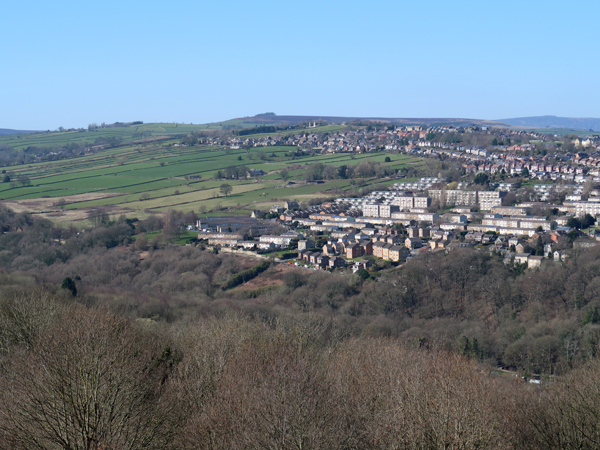
My next day out in March 2022, following my further investigation of Crookes, Walkley and Hillsborough, was to explore the escarpment of Greenmoor Rock than runs from Jawbone Hill along Birley Edge to Wadsley Bridge and then on to Wardsend Cemetery.
 
Taking the No. 86 bus from Sheffield city centre to the Penistone Road/Norfolk Hill stop, I paused briefly to look at the uniformly coloured sandstone that has been used for the Norfolk Arms public house, which I assume is the locally quarried Grenoside Sandstone. 
 
The Norfolk Arms public house

As usual, I had compiled a short list of buildings that did not yet have a photo on the British Listed Buildings website, which included Grenoside war memorial (1922). The wheel head cross is made with roughly hewn Cornish grey granite, with a three stepped plinth made of Grenoside Sandstone. 
 
Grenoside war memorial

Making my way up Norfolk Hill, which I had partly explored during a previous visit to Grenoside, I was interested to see that the Grenoside Sandstone at the base of various walls along the roadside is quite weathered – probably due to the use of road salt along this steep hill in winter – and distinctly yellow in colour. 

Weathered Grenoside Sandstone on Norfolk Hill

Turning down School Lane, I then had a good look at the exterior of the early C19 old School and adjoining Master’s house, now Grenoside Reading Room, where the yellow colour is still very obvious beneath the layer of dirt. 
 
The old School

I didn’t spend any time studying the stonework, but it is very uniform in colour, cross-bedded and with no obvious wild iron banding. I didn’t really take much notice of the very blackened dressings, which could be more massive varieties of the Grenoside sandstone used for the walling. 
 
Greoside Sandstone at the old School House

Continuing up Norfolk Hill, I couldn’t resist having a good look at the former Grenoside Board School, built in 1885 to the design of George Archibald Wilson of the practice Wilson and Masters, who were responsible of a total of 7 schools for the Ecclesfield School Board – of which only the Hillsborough and Low Wincobank schools remain. 
 
The former Grenoside Board School

Having surveyed all of the board schools that are listed in the Victorian Society book: Building Schools for Sheffield, I know that they are all very solidly built and it is a great shame that such a fine building like this is slowly decaying and not being put to good use. 
 
Greno Cottage

Noting the rather elaborate door surround at Greno Cottage, I retraced my steps and carried on up the hill until I reached Grenoside Green, where there is the file cutter's stithy, which I couldn’t recall seeing before, and various sculptural works by Andrew Vickers. 
 
The fille cutter's stithy

Coming out of Grenoside Green onto Main Street, I took a couple of photos of Nos. 139-141, just to record another example of uniformly yellow coloured, medium grained cross-bedded sandstone, before heading up Stephen Lane. 
 
Nos. 139-141 Main Street
 
Very surprisingly, given its industrial history and age of some of the buildings, troughs and other miscellaneous structures, there are only three listed buildings in Grenoside but the Grenoside Sandstone gives the vernacular architecture within the Grenoside Conservation Area a very distinctive character. 
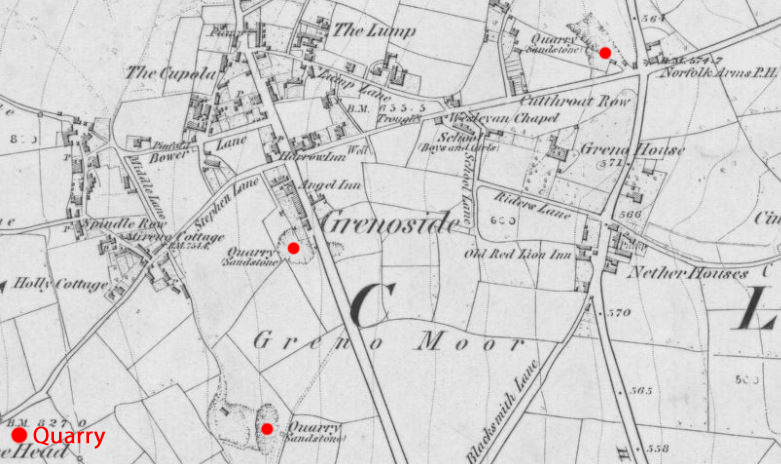
 
The 1855 Ordnance Survey map of Grenoside
 
The 1855 Ordnance Survey map shows three reasonably sized quarries working in the area, which have presumably supplied the Grenoside Sandstone for the old core of the village, with these having being expanded with cranes by the time the 1906 map was published; however, although the LIDAR map suggests the possibility of small sections of old quarry faces still existing in back gardens, I have only seen one old quarry exposure in Grenoside. 
 
Vernacular architecture on Stephen Lane

I continued my walk along Stephen Lane, which gently rises up the dip slope of the Grenoside Sandstone, where there are yet more yellow sandstone houses, where the masonry is in a variable condition and, in places, differential weathering has been repaired with sand and cement. 
 
Sand and cement repairs

Eventually, Stephen Lane continues to rise until it reaches a gentle escarpment of the Grenoside Sandstone, with a series of transmitters set on its edge and overlooking the River Don, but there are no rock outcrops to be seen. 
 
An escarpment of Grenoside Sandstone
 
Leaving Grenoside, the character of the surroundings completely changes, with the uniformly yellow coloured Grenoside Sandstone, seen ubiquitously in the vernacular architecture, suddenly changing to dark rusty brown, thinly bedded Greenmoor Rock in the field boundary walls.
 
A field boundary wall built of Greenmoor Rock


Friday, 7 April 2023

Historic Architecture in Sheffield - Part 4

 
St. George's church

My exploration of Crookes and Walkley and Hillsborough had taken just over an hour and a half, with a distance of nearly 6.5 km covered, and I caught the tram back to Sheffield; however, with the sun still shining, I decided to get off at the Sheffield University stop and then walk into Sheffield. 
 
The west front of St. George's church

The first stop on the way back to the city centre was the former St. George’s church (1825) by Woodhead and Hurst, who had also designed Christ Church (1830) in Stannington and the former Boys’ Charity School at Nos. 31 and 33 York Street – all of which are built with Chatsworth Grit from the Rivelin Valley. 
 
St. George's church
 
The British Listed Buildings website already had photographs of this Grade II Listed church, so I just took a few general record photographs and made my way down West Street, until I came to the Bow Centre (1894), which was designed by J.B. Mitchell-Withers as part of the Central Schools complex of the Sheffield School Board. 
 
The Bow Centre on West Street

The Victorian Society book Building Schools for Sheffield describes the buildings on Leopold Street as being built in Huddersfield stone ashlar, which has probably been used again here, but I only took a few photos from a distance and didn’t look closely at the stone.
 
The west elevation of the Bow Centre
 
I then made my way down Orchard Lane to photograph the Science School (1895), which is also by J.B. Mitchell-Withers and presumably another example of Huddersfield stone. During my first visit to the building the previous year, it was very overcast, but this time the fine details were bathed in light. 
 
The entrance to the Science School

The medium grained Huddersfield stone which is quarried from the Rough Rock, can be ornately carved and is generally very durable but, looking closely, the detailing of the swags on either side of the Sheffield Board School monogram above the entrance are seen to be quite weathered. 
 
The Sheffield School Board monogram and associated stone carving

Making my way down Leopold Street towards Surrey Street, the front elevation of the Grade I Listed Town Hall (1897) was well illuminated by the afternoon sunshine, including the frieze sculptures depicting Sheffield trades by F.W. Pomeroy. 
 
Sheffield Town Hall
 
High above the main entrance are the figures of the gods Thor and Vulcan, supporting the Sheffield coat of arms, which I was able to capture with the zoom lens on my Canon Powershot G7X Mark II camera at its full extent. 
 
Sculptures of Thor and Vulcan
 

Thursday, 6 April 2023

A Further Exploration of Hillsborough

 
The north-west tower at Hillsborough Barracks

Arriving in Hillsborough, after my further exploration of Crookes and Walkley, I went down Forbes Road to take another look at the Ancaster limestone stone carving on the west front of the Church of the Sacred Heart, by Philip Lindsey Clark. 
 
Details at the Church of the Sacred Heart

Walking down to Hillsborough Corner, I photographed Nos. 25 and 27 Holme Lane for the British Listed Buildings website and then had another look at the condition of the weir, which was damaged during the floods of 2019. 
 
The weir at Hillsborough Corner
 
I never tire of seeing the weir and the bridges over the River Loxley here, as the large blocks of the gritstone used in its construction provide good examples of the use of the local Chatsworth Grit from the Rivelin Valley for civil engineering purposes. 
 
The damaged section of the weir

During a visit to Hillsborough the previous year, to look at the Hillsborough Board School, I photographed part of Hillsborough Barracks, which was built from 1848 to 1854 and contains several listed buildings, and this time I photographed those that I had not seen before.
 
The north-west wall and towers
 
According to the Grenoside Conservation Area Appraisal, Hillsborough Barracks is built with Grenoside Sandstone, from its type locality in Grenoside,  and I was therefore particularly keen to have another look at this sandstone, which in Grenoside is distinctly yellow in colour. 
 
Views of the south-east barrack block

The walling of the north-west wall and towers and the south-east barrack block show yellow to slightly orange colour variations in this medium grained sandstone, which contrasts with a coarser grained massive sandstone that has been used for the plinths – possibly another example of locally quarried Chatsworth Grit. 
 
Details of the south-east barrack block
 
To the south side of the south-east barrack block, there are areas of the tarmac covered parking area where the original road setts have been exposed. The sandstone here is quite different in character to the coarse grained stone that I had seen earlier on my walk, with its fine grain size and yellow/brown colour. 
 
Road setts

Quickly looking at various other buildings, including the former mobilization store/fives court and the riding school, similar patterns of yellowish walling, with a lighter coloured massive sandstone for the plinth can also be seen. 
 
The former mobilization store and fives court

Apart from the buildings seen in Grenoside, although the Grenoside Conservation Area Appraisal also mentions that Grenoside Sandstone is used for the old Post Office in Fitzalan Square and for some of the masonry at the Wicker Arches, I don’t any know other buildings in Sheffield where this sandstone is recorded as having been used. 
 
The old guardroom and adjoining tower

The old guardroom, which is now the Garrison Hotel and Guardhouse Bar, is built in similar yellowish stone and I didn’t spend much time looking at it; however, looking at the fortifications that continue along its eastern wall, I was very interested in the very reddened sandstone here. 
 
A section of walling with rifle slits

My terraced house in Treeton is built with Rotherham Red sandstone and, having surveyed countless rock exposures and historic buildings in and around South Yorkshire – looking particularly at the Upper Carboniferous sandstones and associated strata – I only occasionally encounter very red rocks like this. 
 
Reddened sandstone walling

Except for the red sandstone that can be seen at the Rockingham Arms and George and Dragon public houses in the village of Wentworth, which I can’t yet explain as a geologist, I have always thought that such colouration was due to a fire – with the iron bearing minerals in the sandstone being oxidised at great heat. 
 
Details of reddened sandstone
 

Tuesday, 4 April 2023

Crookes and Walkley Revisited

 
Crawshaw Sandstone from Walkley Bank Road (21 mm diameter coin)

On the weekend following my field trip in Doncaster with the Sheffield U3A Geology Group, I returned to Sheffield to have another look at the area around Crookes and Walkley where, 13 months earlier, I had started my investigation of the Crawshaw Sandstone and its use in the Sheffield Board Schools. 
 
The former Hammerton Street Council School

The Crawshaw Sandstone from Bolehills used for the Sheffield Board Schools, as particularly well seen at the Hammerton Street Council School, is uniformly buff in colour, medium grained and is planar bedded. This contrasts with the more massive varieties of sandstone from the Millstone Grit Group in Derbyshire and West Yorkshire, which have been used for dressings and as ashlar in the Central Schools based at Leopold Street. 
 
Although there are very few rock exposures or old quarries in which to see them, when travelling throughout Sheffield to see these schools, I had encountered all of the principal sandstone formations in the city that have supplied building stone of a reasonable quality – as seen in a wide variety of vernacular buildings, boundary walls and paving and road materials, where local sandstone has undoubtedly been used. 
 
Stannington View Road

Catching the No. 52 bus from Handsworth, which links up well with the routes of the buses to Sheffield from Treeton, I walked down to Stannington View road to photograph the old sewer gas lamp for the British Listed Buildings website, before having a quick look at some C19 houses.
 
A Chatsworth Grit kerb stone

Much of the sandstone here is quite iron stained and the planar bedding has differentially weathered, but I would say that Crawshaw Sandstone has been used for the walling, with more massive sandstone used for dressings and Chatsworth Grit for the road kerbs. 
 
A view towards Stannington

I then made my way to Bolehills, stopping briefly to take in the views towards Stannington and have another look at the handful of Crawshaw Sandstone exposures here, before continuing down through the landscaped old quarries to Bole Hill Road. 
 
Views at Bolehills

Continuing to the former Bolehill Board School, I had another look at the Crawshaw Sandstone walling in the caretaker’s house, before walking down Walkley Road to the Walkley Carnegie Library, where it is again used together with Stoke Hall stone dressings. 
 
Crawshaw Sandstone walling

Carrying down Walkley Road, I turned down into the snicket that leads to Parsonage Street, which follows the line of a faulted boundary between the Crawshaw Sandstone and the Middle Band Rock, which is built with rubble stone walls and floored with large coarse sandstone setts. 
 
A snicket from Walkley Road to Walkley Bank Road

With my Estwing hammer, I then collected a couple of small samples of the cross-bedded flaggy Crawshaw Sandstone that is exposed in the retaining wall on the east side of the snicket at Walkley Bank Road, which I had first noticed a few months earlier when exploring the Morley Street and Malin Bridge schools. 
 
An exposure of sandstone on Walkley Bank

Viewed with a hand lens, degraded iron bearing minerals are common in the interstices formed by the quartz grains, with some distinct iron banding and also well defined bedding planes clearly seen with the naked eye. 
 
Fresh surfaces on my specimens of Crawshaw Sandstone

Crossing over the road to Stony Walk, which forms another snicket, I carried down the hill until I reached Woodview Road, where the sandstone used for a terrace of houses comprising Nos. 72-80 has the same characteristics as seen in other houses on my walk so far. 
 
Nos. 72-80 Woodview Road

Noting the coarse sandstone used for more large road setts, which could well be from the quarries in the Loxley Edge Rock at Wadsley Common, with coarser Chatsworth Grit forming the kerbs, I followed Stony Walk down to Walkley Lane. 
 
Road setts and kerb stones at Stony Walk

One of the interesting features of Walkley is the construction details at the junctions of the roads and footpaths, where the coarse sandstone setts form slip resistant surfaces for the pedestrians that use them in winter. I stopped to photograph the road detail on the corner of Walkley Lane/Lonsdale Road before heading down towards Hillsborough.

The junction of Walkley Lane and Lonsdale Road

Sunday, 2 April 2023

A Field Trip in Doncaster - Part 2

 
At Warmsworth Park

My trip to Locke Park in Barnsley was made all the better by a spell of good weekend weather but, by the following week, the rain had returned and this again affected the Sheffield U3A Geology Group field trip that had been planned for this week. 
 
Site locations on the field trip

Perhaps many of the group members who had turned up to the February meeting, which had to be abandoned due to the arrival of Storm Dudley, had been put off by the idea of visiting more old quarries or parking in a few places, but only seven of us turned up on the day - the worst attendance that I had experienced since I had joined the group in November 2015. 
 
The path from Conisbrough Viaduct to the riverside public footpath
 
With rain forecast for the afternoon, we started at our walk at the north end of Conisbrough Viaduct and quickly made our way down a path, which had been very muddy during the recce a couple of weeks earlier, to the main footpath towards Sprotbrough. 
 
Ornamental detailing of the brickwork at Conisbrough Viaduct

Stopping briefly to look at the ornamental detailing of the Staffordshire Blue brickwork, which I thought very surprising for such a utilitarian structure, we then headed along the path to the Nearcliff quarries to look at the spectacular slumps in the dolomitic limestone. 
 
At Nearcliff quarries

Many of the rifts seen here are filled with sandy material, which is very probably loose Quaternary glaciofluvial sand and gravel that has washed down into the voids and, in some places in the quarry, the uppermost beds of limestone are covered in similar loose material. 
 
Glaciofluvial sand and gravel on the top of the limestone
 
Returning to our cars, we then set off to the Church of St. John the Evangelist at Cadeby, where we had lunch and had a look at the various sedimentary and deformation structures, which are visible in the dolomitic limestone used for the walling. 
 
Lunch at the Church of St. John the Evangelist
 
For the afternoon session, we started at the old building sand quarry that was once used as the Cedar Road adventure playground, which has fine examples of Triassic sandstone from the Chester Formation, which has a channel deposit with mudstone clasts. 
 
The Chester Formation at Cedar Road quarry
 
Here I obtained a sample of the fine grained red sandstone, which does not contain an abundance of pebbles like the same rock formation further south in Nottinghamshire, together with small samples of brown mudstone. 
 
Sandstone and mudstone from Cedar Road quarry
 
With the rain starting to fall, we didn’t all venture up the slippery slopes to the deposit of glaciofluvial sand and gravel that overlays the sandstone, but I instead went to obtain a few pebbles that are typical of those found in Quaternary deposits like this in Doncaster. 
 
Glaciofluvial pebbles

By the time we reached Warmsworth Park, to look at the Sprotbrough Member of the Cadeby Formation, the rain was falling steadily but we were still able to examine the principal features that had been identified in the old quarry. 
 
The Sprotbrough Member at Warmsworth Park
 
Having spent so much time organising this and the abandoned field trip the previous month, it was worth enduring a bit of discomfort in the increasingly heavy rain and we managed to spend a good full day out, with it being nearly 4 o’clock in the afternoon before we finally finished.  

At Warmsworth Park